
The Shahed drone is a factory, not an aircraft: how a simple Iranian design turned air defense into a production race
The Shahed-136 is a slow, cheap Iranian one-way attack drone that Russia builds as the Geran-2 by the thousand every month. My argument is that what makes this weapon of terror dangerous is the factory behind it, and that it turned air defense into a race between production rates. Here is the mechanism, the numbers and where the race goes next.
The Shahed drone is a triangle of composite with a lawnmower-sized engine at the back and a warhead at the front, and it has become the long-range strike weapon Russia launches at Ukraine in the largest numbers. It is an Iranian design, the Shahed-136, that Russia licensed in 2022 and builds as the Geran-2. Nothing about it is advanced. The airframe changed little; the production system underneath it changed completely, from imported kits to a Russian supply chain that ships thousands a month despite sanctions on most of its electronics.
My argument is that the Shahed is a factory before it is an aircraft. It is slow, loud and easy to hit one at a time, and Russia does not care, because it is cheap enough to launch by the thousand at Ukrainian homes, power plants and hospitals every month. It did not succeed because it is a good product. It succeeded because it can be built in mass, cheaply, by workers who need no special skills. A weapon built for terror by volume turned air defense into a race between two production lines, Russia's drones and the defender's answers, and everything that has happened since follows from it. Understanding that factory is how the defender wins the race.
Where did the Shahed come from?
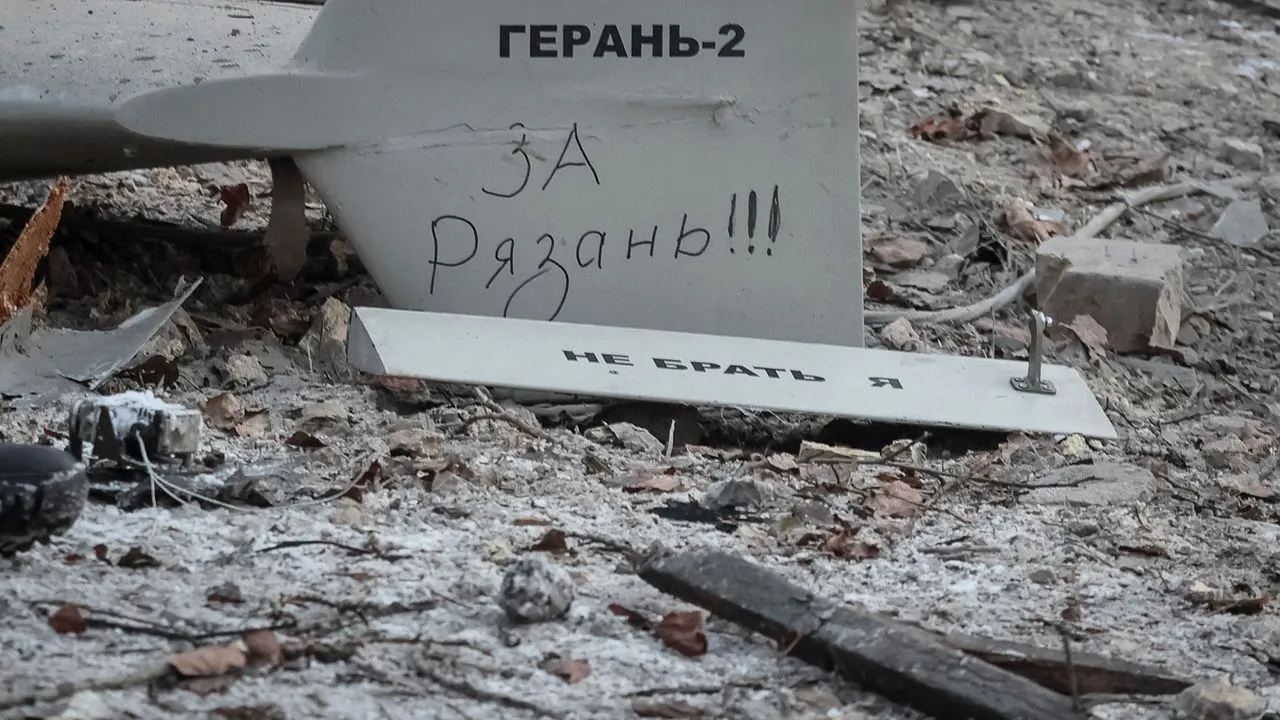
The Shahed-136 was designed in Iran by HESA and Shahed Aviation Industries as a long-range one-way attack drone: launched from a rail with a rocket booster, it flies a preset route and dives onto its target. Russia received its first shipment of Shahed-131 and Shahed-136 drones in mid-August 2022, about six months into the full-scale invasion. Ukrainian forces recovered the first wreckage near Kupiansk on 13 September 2022; it was Iranian, but already marked with the Russian name Geran-2, “geranium-2”.
About two months after the first transfer, a Russian industry delegation went to Iran to finalize a reported $1.75 billion deal to build the drone in Russia, at the Alabuga Special Economic Zone in Tatarstan. Alabuga started by assembling Iranian kits and moved, step by step, to Russian and Chinese components. The exact terms of the deal, the intellectual-property rights and the payment schedule have never been made public.
The Shahed-136 and Geran-2 in numbers
| Figure | Value |
|---|---|
| Layout | Tailless delta wing, rear pusher propeller, rail launch with a rocket booster |
| Length, wingspan | about 3.5 m, about 2.5 m |
| Weight | about 200 kg |
| Warhead | 30 to 50 kg originally; about 90 kg on modified Russian airframes |
| Engine | Mado MD-550, a four-cylinder piston engine of about 50 hp, widely described as a copy of Germany’s Limbach L550E |
| Speed | about 185 km/h |
| Range | 1,000 to 2,500 km depending on version; about 1,000 km for the 90 kg version |
| Navigation | satellite navigation with Russian Kometa anti-jam antennas, moving from 8-channel to 12-channel versions |
| Estimated cost | as little as $35,000; other estimates near $50,000 |
The cost is an estimate, not a Russian contract price. It is still the number that matters most, because it sets what a defender can afford to spend stopping one.
How many does Russia make, and how many does it launch?
The scale is the point. Ukraine’s intelligence reported Russia’s 2025 plan as 79,000 Shahed-type drones: 40,000 Geran-2s, 5,700 Garpiya-1s and about 34,000 Gerbera and other decoys. By August 2026 it assessed actual output at about 2,800 Geran-2s a month, plus about 3,000 jet-powered Geran-4s and Geran-5s, so the jet versions now outnumber the original.
Launches follow production. CSIS estimated 5,000 to 6,000 Shahed launches a month in the second half of 2025. In May 2026 Russia launched 8,161 Shahed-type drones including decoys, an average of 263 a day, of which an estimated 5,181 were armed Geran strike drones. Those headline totals need care: in April 2026 armed Shaheds were only about two thirds of all Shahed-type launches, and the rest were mostly decoys.
The decoys deserve a line of their own. The Gerbera is built from plywood and foam, looks like a Shahed on a radar screen and exists to make the defender spend an interceptor on nothing. Planning 34,000 of them next to 40,000 armed drones tells you how Russia thinks about the defender’s budget.
From propeller to jet: the Geran-3 and after
Iran unveiled the jet-powered Shahed-238 in 2023. Russia’s version is generally called the Geran-3, and newer jet variants are reported as the Geran-4 and Geran-5; the names and boundaries between them are not consistently disclosed. Ukraine’s intelligence reported Russia setting up jet production in February 2025, and wreckage turned up in Ukraine in early June 2025.
Reported speeds range from 300 to 370 km/h for a version with a Chinese Telefly JT80 engine up to about 600 km/h for others. That range is the whole story for the defender. At 185 km/h a Shahed can be chased by a cheap interceptor drone or hit by a machine-gun team. At 500 km/h and more it cannot, which is why Russia launched five times as many jet drones in July 2026 as in June, why Ukraine's faster interceptors now wait on engines, and why the same logic produced the Banderol cruise missile.
How does Ukraine bring them down?
In layers, and increasingly cheaply. Ukraine reported about 6,500 long-range drones launched in March 2026 and an interception rate just over 85%, and its digital transformation minister put the rate at 90% in April, as reported by Reuters. By then interceptor drones, priced in the low thousands of dollars, accounted for about 40% of the shootdowns, up from roughly a quarter during the winter. Acoustic sensors cue mobile fire teams, and Ukrainian F-16s can each down as many as ten Shaheds in a night.
The arithmetic behind that shift is the one I go through in cost-exchange ratio: a $3 million missile against a $35,000 drone is a loss even when it hits. The jet versions reopen that gap, which is the subject of why a cheap cruise missile is hard to stop.
Where is the Shahed race going?
The race has no finish line. It runs on two parallel tracks: Russia fields something new, Ukraine finds the counter, and Russia answers with something else. Against the propeller Geran-2 the counter worked. At its best, interceptor drones, mobile fire groups and conventional air defense together were bringing down up to about 95% of ordinary Shaheds. Russia's reply was not a better propeller drone but a jet one, and against that there is no interceptor yet that does the job well. Each round is won by the side whose answer is cheaper and faster to produce than the other side's threat. I expect three things over the next two years.
- The fleet splits in two. The propeller Geran-2 becomes the mass and the decoy, launched to exhaust sensors and interceptors; jet versions do the striking. Raids become mixes designed to make the defender choose wrongly, and the defender's real problem becomes classification, not interception. The decoy side is already growing teeth: the Gerbera-2 carries a warhead and incendiary fuel, as I set out in Gerbera-2 turns Russia's decoy drone into an arsonist. Iran used the same mix of drones and missiles against US and Gulf defenses in 2026, and it drained American interceptor stocks, as I set out in how Iran made the US pay for its air defense.
- The next upgrade is in the electronics, not the engine. The Geran-5 already carries a mesh-network modem and 3G/LTE antennas. Coordination between drones in a raid, and terminal guidance that does not depend on satellite navigation, are the cheap upgrades a factory can add to a frozen airframe.
- The design leaves the war. Russia learned it from Iran and, by Zelensky's account, is sharing the jet technology with North Korea. Once a weapon is a factory product, it is exported as a factory. Any Western base or city in reach of a country that buys the factory faces the same arithmetic, which is why the Pentagon is testing lasers over its own bases in the counter-drone directed energy pilot.
Signals worth watching: the share of jet-powered drones in each raid; Alabuga's reported monthly output against Ukraine's interceptor output; the share of kills made by interceptor drones rather than missiles; and Shahed-type drones appearing in other theatres.
What will the market need next?
The defense against the Shahed is a market with buyers on three continents now, and its most valuable product is not the one people expect. Russia mixes real Geran-2s with Gerbera decoys in the same raids against Ukrainian cities, so the costliest mistake a defender makes is spending an interceptor on a decoy. Software and sensors that tell a $35,000 attack drone from a cheap decoy before anything is fired save more money than any single interceptor, and almost nobody sells them as a product outside Ukraine.
The second market is physical protection. Russia aims Shaheds at power plants and substations to leave Ukrainian cities without heat and light, and energy companies buy shelters, barriers and screens for equipment that cannot be moved. The same buyers now exist in Europe and the Gulf.
The third is the cheap layer itself, sold as a package: mobile fire groups with their vehicles, thermal sights and guns, interceptor drones, and the crews trained to use them. Gulf states learned in 2026 that the drones are easier to buy than the people, as I describe in how Iran made the US pay for its air defense.
Signals worth watching: decoy share in Russian raids, energy-sector tenders for physical protection against drones, and Ukrainian interceptor teams contracted abroad.
What a defense-tech founder should learn from fighting it
Not a model to admire: a production system the defender has to out-build. Three things follow, all of them about production rather than the airframe.
- Localization is a schedule, not an event. Alabuga went from assembling Iranian kits in 2022 to building thousands a month with Russian and Chinese parts. The design barely changed; the supply chain under it changed constantly. Ukraine’s intelligence found a US-made Xilinx Kintex-7 chip in one antenna version replaced by a Chinese circuit in the next.
- Freeze the airframe, iterate the parts. The Geran-2 of 2026 looks like the Shahed-136 of 2022 and carries a heavier warhead, a better antenna and different electronics. That is how a product scales without breaking its line, the problem I describe in why one to a thousand is the hard part.
- The cheapest unit sets the market. A $35,000 drone launched by the thousand created a market for interceptors at a few thousand dollars, and a jet version at several times the speed is creating the next one. Whoever builds the answer has to price it against the threat, not against the budget of the buyer. What happens as the volumes keep growing is in the risks at 80, 150 and 400 a month.
Sources (11)
- CSIS, “Shahed to Geran: How Russia Continues to Reinvent the One-Way Attack Drone,” 9 April 2026
- Ukrainska Pravda, Russia plans to produce 79,000 Shahed drones in 2025, 13 August 2025
- Militarnyi, Russia produces about 2,800 Geran-2 drones per month, 3 October 2026
- Militarnyi, production of Geran-4/5 jet drones has surpassed Geran-2, 15 August 2026
- Militarnyi, Russians significantly modernized Shahed and Gerbera drones, 1 October 2026
- Institute for Science and International Security, May 2026 analysis of Shahed-type UAV deployment
- CSIS Missile Threat, Shahed-238, 2 June 2026
- Euronews, the drones Russia could use to strike Europe, 25 September 2026
- Reuters, inside Ukraine’s drive to defeat the Shahed drone, 29 April 2026
- Reuters, what are Gerbera drones, 10 September 2025
- Defense News, interceptor drones and air-defense economics, 5 March 2026
Where this comes up on the site
- The Geran-5 and the end of the cheap-drone era: Russia's jet Shahed, and why only 57% are shot down
- The Geran-5 K5 is not Russian ingenuity. It is a 1970s navigation trick bolted on because Ukraine's jamming works.
- Too proud to take Ukraine's $2,000 answer to Iran's Shaheds, the Pentagon paid in American lives and billions