
The Geran-5 and the end of the cheap-drone era: Russia's jet Shahed, and why only 57% are shot down
The Geran-5 is the jet-powered successor to the Shahed drone, built at Alabuga with a Chinese turbojet and flying about three times faster than the original. Here is what it is, the numbers, what it costs and what it changes for anyone building the defense against it.
The Geran-5 is a Russian jet-powered strike drone, one of the fastest members of the family that began with Iran's Shahed-136. Where the original Shahed is a slow delta wing with a loud piston engine, the Geran-5 has a conventional aircraft layout, a small Chinese turbojet and the shape of a cheap cruise missile. Ukrainian intelligence lists its cruise speed at 450–600 km/h, against 150–180 km/h for the piston Geran-2. That speed is why Ukraine's President said on 28 September 2026 that his forces were downing 70% of all Shahed-type drones but only 57% of the jet ones.
Russia uses it the way it uses every Shahed: against Ukrainian cities, energy and civilians; on 28 September 2026 one hit a hospital building in Kyiv, by the President's account. My argument is that the Geran-5 marks the end of the cheap-drone era as it was understood in 2022. Russia gave up the Shahed's defining advantage, a price low enough to waste, in exchange for speed, and in doing so moved the weapon toward the cruise missile. Cheap drones do not disappear: the Geran-2 is still built at about 2,800 a month and flies in the same raids as filler and decoy. What ends is a single cheap, slow threat the defender could price its whole answer against. The interesting market is now the one in between: strike weapons and interceptors priced from tens of thousands to a few hundred thousand dollars, built by the thousand.
Where it came from
The first jet version, the Geran-3, appeared in early 2025: a standard Geran-2 airframe with a Chinese Telefly JT80 turbojet in place of the piston engine. With about 80 kgf of thrust it roughly doubled the speed, to 300–350 km/h, but lost range and warhead, as Meduza's analysis describes. Russia then moved to a much more powerful engine from the same Chinese maker, the Telefly TF-TJ2000A, with about 2.5 times the thrust. It went into two airframes: the Geran-4, which keeps the Shahed's delta wing, and the Geran-5, a new conventional design that can also be launched from aircraft and helicopters. Both are built at Alabuga in Tatarstan, the plant that made the Geran-2 in its thousands. The older family is explained in the Shahed and Geran drone.
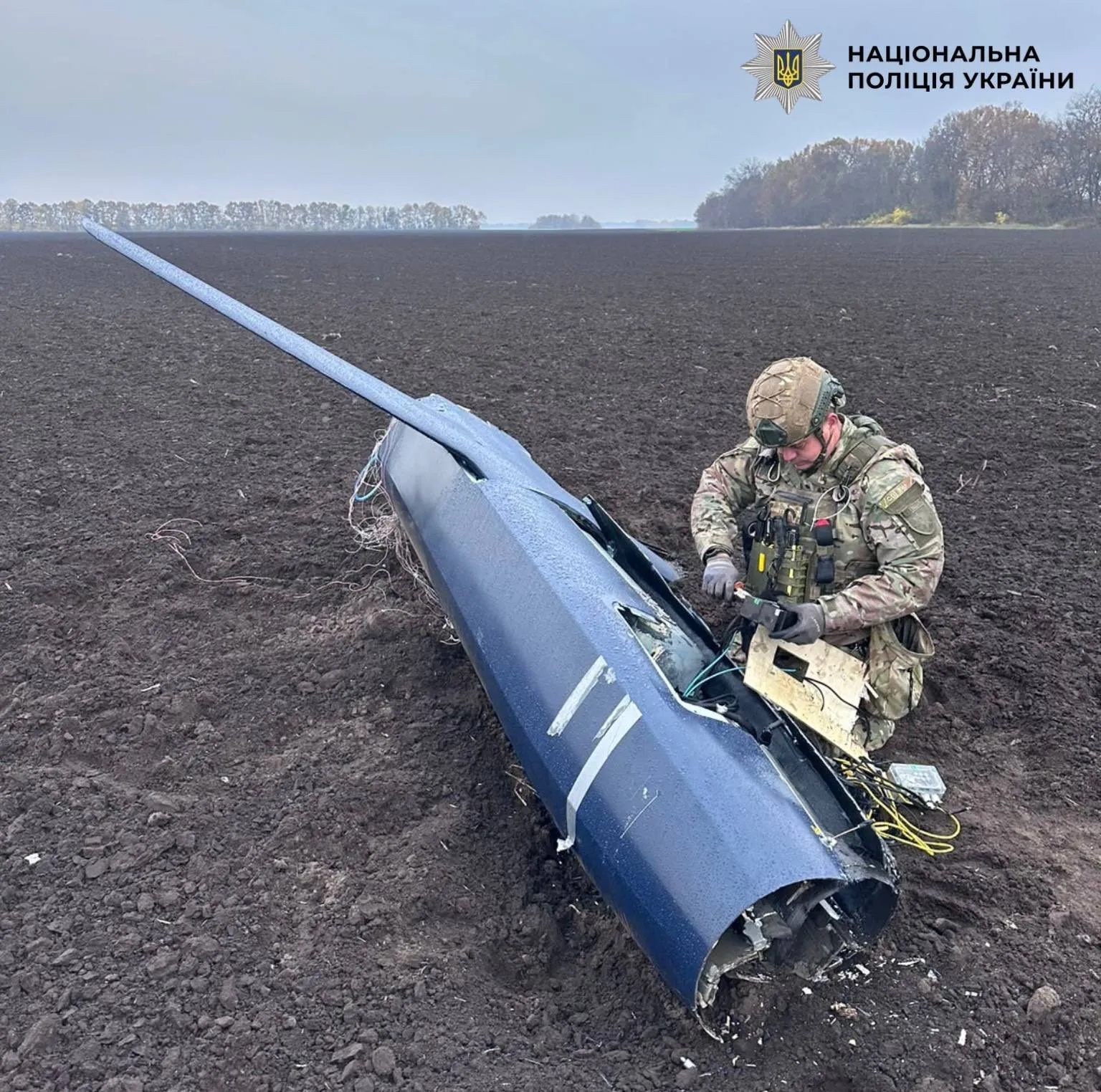
The specifications
| Geran-5, as listed by Ukraine's Defence Intelligence | |
|---|---|
| Length / wingspan | 6.5 m / 3.2 m |
| Maximum take-off weight | 850 kg |
| Warhead | 90 kg (BCh-90) |
| Engine | Telefly TF-TJ2000A turbojet, made in China |
| Cruise speed | 450–600 km/h |
| Range | 950 km |
| Flight time | up to 2 hours |
| Altitude | up to 6,000 m |
| Navigation and links | inertial navigation unit, satellite navigation, 3G/LTE antennas and a mesh-network modem |
| Manufacturer | Alabuga special economic zone (JSC "OEZ PPT Alabuga") |
The same intelligence catalogue lists the parts recovered from downed drones and the countries their makers are based in: China above all, but also components from companies in the United States and Germany. A Geran-5 documented in January 2026 carried the Kometa-M12 anti-jam satellite antenna; Kometa is the reason jamming alone does not bring it down.
How is it used?
As a fast strike weapon against cities and infrastructure, mixed into raids with slower drones and decoys. On the night of 26–27 September 2026, Ukraine's Air Force counted 170 Shahed-type drones, 76 of them jet-powered, alongside Gerbera and Parodiya decoys. On 28 September, by the President's count, more than 120 drones attacked during the day, 90 of them jets; one reached the border with Poland, and Meduza reports a Geran-5 hitting a border crossing almost 600 km from Russia. In some recent attacks on Kyiv, the Kyiv Independent reported, jets made up about two-thirds of the drones launched, and by Zelensky's count more than 900 were launched in the week to 4 October.
What does it cost, and how many are made?
Experts quoted by Meduza put a finished Geran-5 at more than $100,000, over twice the price of a Geran-2, whose piston engine costs up to $10,000; the Chinese turbojets alone sold for tens of thousands of dollars each. That is still several times cheaper than a Kalibr or a Kh-101.
Volume is the other half. Ukraine's Defence Intelligence estimated in August 2026 that Russia makes about 3,000 Geran-4 and Geran-5 a month and about 2,800 Geran-2, so monthly production of the jet versions has overtaken the Geran-2. Zelensky said on 26 September that Russia plans to spend $12 billion next year on jet drones and loitering munitions, and on 4 October that Russia has shared the jet-drone technology with North Korea, as the Kyiv Independent reported.
What does it change for the defender?
Much of what Ukraine built against the Geran-2 was tuned to a slow, loud target.
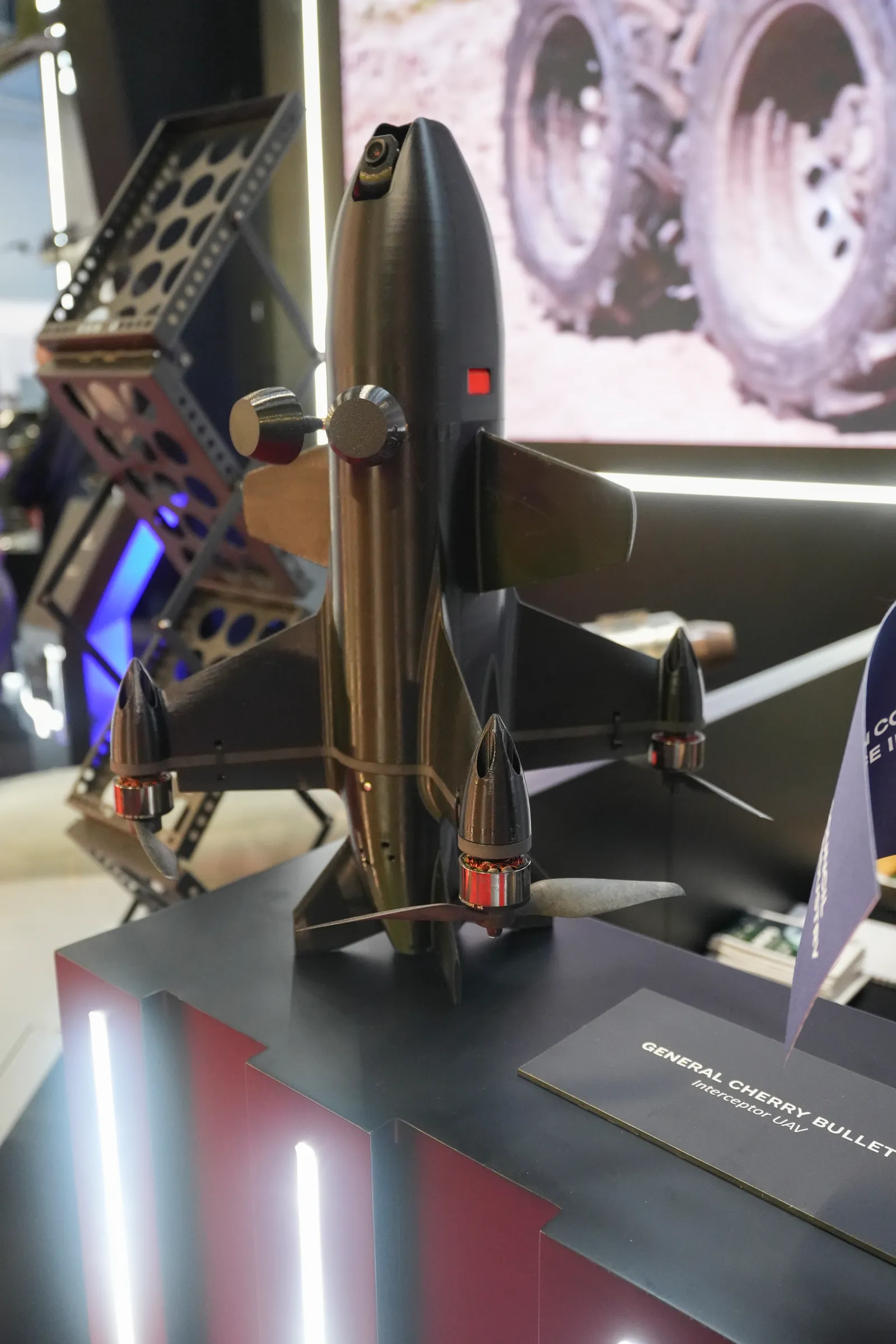
- Interceptor drones are too slow. The electric interceptors that made the Geran-2 uneconomical fly at about 280–300 km/h; a target at 450–600 km/h has to be met head-on or not at all. Ukraine is testing five types of high-speed interceptors, and the bottleneck is the engine, as I set out in the jet-interceptor engine bottleneck.
- The sensors hear less. The acoustic network that tracked the Geran-2 by the sound of its piston engine, Sky Fortress, was built for a different noise and a slower target. Radar and optical cueing matter more.
- The cost-exchange ratio moves, both ways. At $100,000 a Geran-5 is no longer cheap, so an interceptor at $10,000–$30,000 that kills it reliably, with the sensors and crews behind it, is a good trade; a $1 million missile is still a bad one. The arithmetic is in cost-exchange ratio.
- The money is arriving. Germany's 4 October package funds joint production of interceptors against jet drones, and Quantum Systems announced German financing for tens of thousands of interceptors built in Ukraine; who builds what is in German-Ukrainian defense joint ventures.
For a company that builds sensors, interceptors, engines or directed-energy weapons, the Geran-5 sets the specification: a target at up to 600 km/h, dozens in a single raid and hundreds a week, at about $100,000 each. The same threat is why the Pentagon is testing lasers over its own bases in the counter-drone directed energy pilot.
What changed in the K5 version?
In September 2026 a version marked K5 appeared. It adds an optical navigation module, called Susanin, that compares camera images of the ground with stored maps when Ukrainian jamming blocks satellite signals; it moves the engine from a pod into the fuselage for speed; and a captured Geran-5 examined in June carried a 90 kg thermobaric warhead, built to kill more people inside buildings. Russia is also testing launches from aircraft and an air-to-air missile against the Ukrainian aircraft that hunt these drones. I go through each change, and why each is a reaction to Ukraine's defense rather than a breakthrough, in the Geran-5 K5 and Susanin navigation.
Where does the jet Shahed lead?
Today there is no interceptor that reliably stops it. Interceptor drones bring down very few jet Shaheds, and the jet versions pull down the overall rate: 57% against 70% for all Shahed-type drones in September. I do not expect a final answer from either side. Attack and defense run on parallel tracks: Russia fielded the jet, Ukraine will find the counter, and Russia will answer that with something else. The question for a builder is not who wins but who keeps up.
I expect drones and cruise missiles to converge from both ends. Russia's jet drones get faster and better navigated; its cheapest cruise missiles, such as the Banderol, get cheaper and more numerous. Within a few years the distinction between a jet drone and a small cruise missile will be one of marketing, not engineering.
That convergence decides what the defender has to build. Missiles that cost millions are too expensive to fire at a $100,000 target in the hundreds; electric interceptors at a thousand dollars are too slow. The answer is a middle layer of interceptors in the tens of thousands, made by the thousand, with engines that are themselves a supply-chain problem, and sensors fast enough to hand them a track. Whoever builds that layer at scale sells to every country in range of a Russian, Iranian or North Korean factory.
Signals worth watching: Russia's monthly output of jet versions against the propeller Geran-2; the price of the first jet interceptors that reach Ukrainian units in numbers; and jet-drone designs appearing outside Russia.
What will the market need next?
The Geran-5 creates a market by price band. Electric interceptors at a thousand dollars are too slow for it, and missiles at millions are too expensive to fire at it in the hundreds, so the product buyers lack is an interceptor in the tens of thousands of dollars that meets a target at up to 600 km/h. Germany's 4 October package funds joint production of exactly that, which tells a supplier where the first orders will be placed.
Detection is the second gap. Ukraine's acoustic network was tuned to the slow, loud piston Shahed, and a jet target needs radar and optical cueing that can hand a fast track to an interceptor in seconds. Makers of small radars and electro-optical sensors priced for dense networks will sell to the same buyers.
The less obvious buyers are in Asia. If Russia shares jet-drone technology with North Korea, as Ukraine's president said on 4 October, South Korea and Japan will need the same layers, and they will look to the companies that built them against Russian drones over Ukrainian cities.
Signals worth watching: unit prices of jet interceptors in German and Ukrainian contracts, orders for sensor networks able to track fast low targets, and counter-drone purchases in South Korea and Japan.
Sources (8)
- Ukraine's Defence Intelligence (War & Sanctions), Geran-5 components and specifications
- President of Ukraine, address of 28 September 2026 (70% and 57%)
- Ukrainska Pravda, Air Force report for 26–27 September 2026
- Meduza, Russia's new jet-powered drones and the cost of shooting them down, 29 September 2026
- Kyiv Independent, Russia sharing jet-powered drone tech with North Korea, Zelensky says, 4 October 2026
- Militarnyi, production of Geran-4/5 jet drones has surpassed Geran-2, 15 August 2026
- Federal Government of Germany, press conference of Chancellor Merz in Kyiv, 4 October 2026
- Quantum Systems, Merz announces interceptor-drone package, 4 October 2026
Where this comes up on the site
- The Geran-5 K5 is not Russian ingenuity. It is a 1970s navigation trick bolted on because Ukraine's jamming works.
- Ukraine's answer to the jet Shahed is held up by one part, and it is not the drone. It is the engine.
- The Shahed drone is a factory, not an aircraft: how a simple Iranian design turned air defense into a production race