
The Orion drone failed as Russia’s copy of the Predator and became a carrier for cheap missiles fired at Ukraine. That shift says where expensive drones are heading.
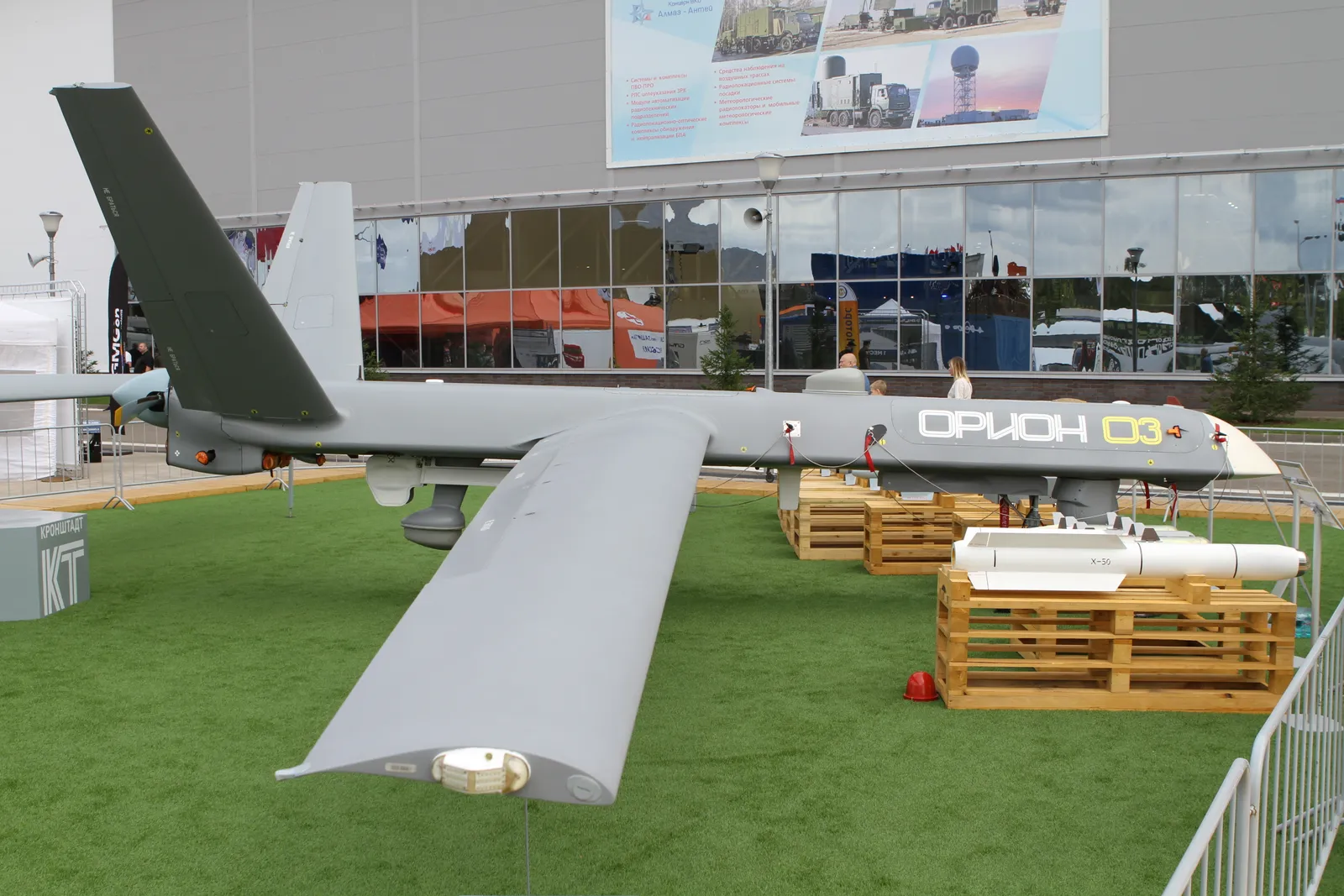
Orion, also called Inokhodets, is Russia’s medium-altitude long-endurance strike drone, built by Kronshtadt in Dubna. It was meant to be Russia’s Predator. Its more important job may turn out to be carrying the cheap Banderol cruise missile.
The Orion drone is Russia’s version of the American Predator: a propeller-driven aircraft with a 16-metre wing that flies for a day at a time, watches, and drops small guided bombs. It is built by Kronshtadt in Dubna, outside Moscow, and it was never made in large numbers. Its story matters for a different reason. The same company and the same town now make the Banderol, the cheap cruise missile the Orion carries, which turns a modest surveillance drone into the launch platform for a weapon built by the hundred.
My argument is that the Orion's career is a forecast for expensive drones in general. As a strike aircraft in its own right it was too costly, too slow and too easy to shoot down to matter. As a reusable carrier for a cheap, mass-produced missile fired at Ukrainian ports and cities from outside the defender's reach, it is more dangerous. The value has moved from the platform to the combination, and that shift is happening on both sides of the war in Ukraine.
What is the Orion?
Orion, also known by its program name Inokhodets (“pacer”), is a medium-altitude long-endurance (MALE) reconnaissance and strike drone. Development began around 2011 under a defense ministry program; Kronshtadt won the development contract in October 2015, and the first flight came in 2016. The first batch reached the Russian military for trials in 2020. An export version, Orion-E, has been marketed with Rosoboronexport toward Asia, the Middle East and North Africa since 2020, with no confirmed foreign buyer in public.
The Orion in numbers
| Figure | Value |
|---|---|
| Maker | Kronshtadt, Dubna |
| Maximum takeoff weight | about 1,000 kg (1,150 kg for Orion-E) |
| Length, wingspan | about 8 m, 16 to 16.3 m |
| Payload | 200 kg in early specifications; 250 kg by Ukraine’s intelligence |
| Speed | about 120 km/h cruise, 200 km/h maximum |
| Ceiling | about 7,500 m |
| Endurance | 24 hours with a light payload; up to 30 hours by Ukraine’s intelligence |
| Control range | about 250 km, 300 km with a relay |
| Weapons | KAB-20 and KAB-50 guided bombs, Kh-BPLA guided munitions, Vikhr-1V anti-tank missiles, the S8000 Banderol cruise missile |
| Production | 24 aircraft by May 2025, by an outside database estimate; no official figure |
Where has it flown?
Russia tested it in Syria in 2018 and 2019. In Ukraine it appeared in the first weeks of the full-scale invasion: by early April 2022 open-source video showed six strikes on Ukrainian vehicles, and Ukraine shot one down near Kharkiv on 7 April 2022. It was later reported over Mariupol and in the Kursk and Sumy areas in 2024. Open-source counts put Orion losses at nine by December 2025, a lot for a fleet measured in dozens.
In July 2026 Russian footage showed an Orion with a Banderol-type missile under its wing, confirming what Ukraine’s intelligence had said since 2025: the Orion is the Banderol’s carrier, with an adaptation for the Mi-28N attack helicopter in progress. A drone with a 250 km control radius carrying a missile with a 500 km declared range is a different weapon from the drone alone.
Why is the Orion produced in dozens and the Banderol in hundreds?
Because they are different kinds of products, and Kronshtadt runs both. The Orion is a reusable aircraft with a datalink, sensors and a ground station, built in a dedicated drone plant in Dubna built in nine months between April and December 2021 and run in three shifts after the invasion. Its output is a matter of airframes and crews. The Banderol is a consumable built to relaxed military requirements around a hobby-market engine, and its output is a matter of parts.
That contrast is the useful part for anyone building in this market. A platform company sells dozens and lives on support contracts; a munitions company sells thousands and lives on its line. The two need different factories, different supply chains and different investors, a point I go through in why one to a thousand is the hard part.
How exposed is it to sanctions?
Less than it should be. Kronshtadt itself has been under EU sanctions since 15 March 2022 and under UK sanctions as well. But in November 2025 Ukraine’s intelligence published the 43 Russian companies in the Orion production chain and said a third of them were not sanctioned by any country in the coalition, leaving open routes for critical components. The plant has also become a target: on 29 May 2025 Ukrainian drones damaged a production workshop at the Dubna site.
Where does this lead?
I expect three developments over the next two to three years.
- Large drones become launchers. Russia is already adapting the Banderol for the Mi-28N helicopter. The same logic applies to Western medium-altitude drones: an MQ-9-class aircraft is far more useful carrying cheap stand-off munitions than flying over a defended area itself.
- The carrier becomes the target. If the threat is the combination, the cheapest place to break it is the carrier and its factory. Ukraine's strike on the Dubna workshop in May 2025 and the Orion's high loss rate point the same way: the defender hunts the launch platform, not only the missile.
- Carriers get cheaper or move to the ground. A fleet measured in dozens cannot feed a missile built by the hundred. Either the carrier gets cheaper and more numerous, or more launches move to ground launchers and helicopters, and the Orion goes back to watching.
Signals worth watching: which platforms launch Banderols, Orion losses against reported production, and whether Western drone programmes start buying cheap stand-off munitions for their existing fleets.
What the Orion says about the market
The Orion did not change the war by itself. It is expensive, slow and few, and it has been shot down often. What changed is what it carries. Pairing an existing platform with a cheap, mass-produced munition multiplies the value of both, and it is the move the defender has to plan for: the threat is not the drone and not the missile, but the combination and the rate at which it can be fed. Combining is getting easier on both sides: many makers now build on relatively open platforms, so fitting a new payload to a carrier takes months, where closed code once made an integration a matter of years. For the defender’s side of that problem, see cost-exchange ratio and the risks at 80, 150 and 400 a month.
What will the market need next?
The Orion's lesson is that the combination of carrier and munition is the threat, and that gives the market two products. On the attack side of every army, kits that let an existing drone or helicopter carry and launch cheap munitions, with the mounts, the wiring and the software to integrate them. Many makers now build on relatively open platforms, so this is months of work, not years, and integrators who do it repeatably will sell to several armies at once.
On the defense side, the carrier is the cheaper target. A Russian medium-altitude drone flies slowly and in small numbers, and an interceptor that can climb to it and destroy it removes every munition it would have launched. Air-to-air interceptors for large drones, cheaper than a fighter's missile, are a gap I expect European and Ukrainian makers to fill.
Signals worth watching: Russian launches of Banderols from Orions and helicopters, Western contracts to arm medium-altitude drones with low-cost munitions, and interceptor programmes aimed at large drones.
Sources (8)
- Ukraine Defence Intelligence on Orion production, via Komersant, 21 November 2025
- Militarnyi, satellite images reveal damage to Kronshtadt plant’s production workshop, 30 May 2025
- Armada International, the first Russian large-UAV plant and the Orion-E project, 7 January 2022
- Long War Journal, Russia’s Banderol low-cost cruise missile officially breaks cover, 17 July 2026
- Deagel, Orion, 12 May 2025
- Defence Blog, Ukraine claims it shot down Russia’s newest armed drone, 9 April 2022
- GlobalSecurity.org, Orion
- OpenSanctions, Kronshtadt