
Russia’s Banderol cruise missile, a parcel built from parts anyone could order
Ukraine’s intelligence took a Russian S8000 apart and published what was inside. Read like a bill of materials, it describes an industrial product more than a technical breakthrough, and that is the part the defense industry should study.
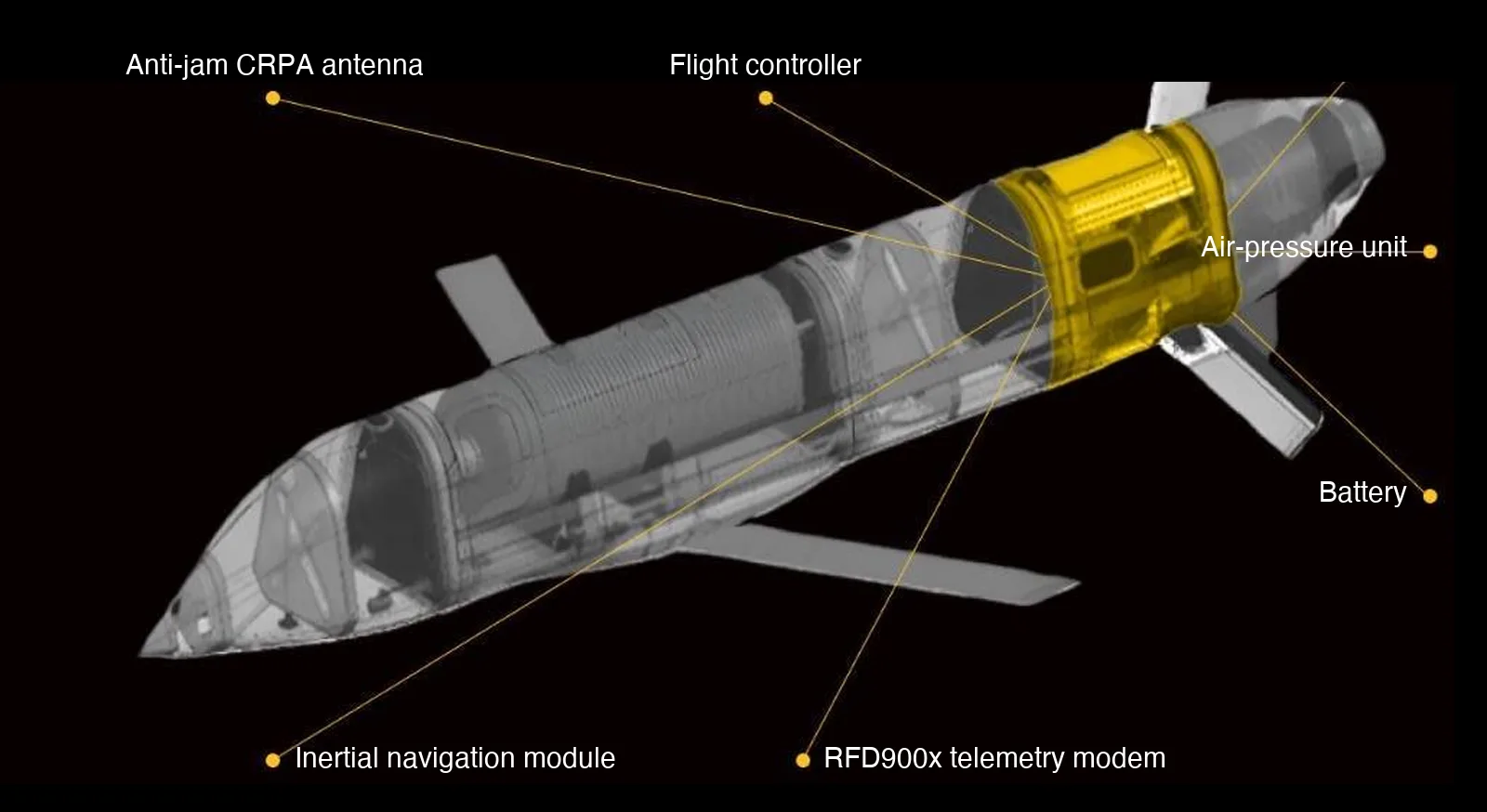
The Banderol cruise missile is a parcel assembled from parts anyone could order online, and that is exactly why it matters. Ukraine’s Defence Intelligence took one apart in 2025 and published what was inside. I read that list the way I read a bill of materials before a sourcing decision, and what it describes is an industrial product: a small composite airframe, a turbojet sold for heavy radio-controlled models, electronics from seven countries, and a line near Moscow turning out two or three a day.
It is built to terrorise. Russia fires it at Odesa and the ports and ships that keep Ukraine's economy alive, and a cheap missile made from mail-order parts means more of those strikes for the same money. Reading its parts list is how the defender, and the countries enforcing sanctions, take that advantage away.
What is the Banderol?
- Maker: Kronshtadt, the company behind the Orion heavy strike drone, which carries the missile. Series assembly runs in Dubna, next door to the plant and design bureau that built the Kh-101, Russia’s main long-range air-launched cruise missile, for decades: shared people, a shared test base, shared logistics.
- Size: about 5 m long, 30 cm in diameter, folding wings just over 2 m across, 200 to 250 kg at launch. The body is composite, which together with the small diameter makes it a poor radar reflector without being stealthy.
- Speed and range: 520 to 560 km/h in cruise, 620 to 650 km/h at most. Declared range is 500 km; after studying series missiles, Ukraine’s intelligence puts the practical figure at 350 to 400 km.
- Warhead: high-explosive fragmentation, 114 kg in total, 49.5 kg of it explosive.
- Price: estimates run from $50,000 to $300,000 a missile. Even the top of that range is several times below a Kh-101.
- Output: about 80 a month as of August 2026, by Ukraine’s intelligence estimate. That is two or three a day across three shifts.
The full set of numbers, and what each one means for the side that has to stop it, is in the S8000 specifications, number by number.
What the parts list tells you
The engine is a Swiwin SW800Pro, a Chinese turbojet of 8.5 kg that gives about 82 kgf of thrust. It was designed for heavy radio-controlled aircraft and civilian jet drones, the same class of engine Ukraine's faster interceptors now compete for, and sold for years on open marketplaces, next to quadcopter spares, for about $16,000 apiece. Around it, Ukraine’s intelligence counted 24 foreign components from seven countries: Murata battery cells and Toshiba phototransistor couplers from Japan, STMicroelectronics STM32 microcontrollers, Texas Instruments and Analog Devices regulators, timers and interface chips, an InvenSense six-axis motion sensor at the heart of the inertial unit, an RFD900x telemetry modem from Australia’s RF Design, and Dynamixel servos from South Korea’s Robotis, built for robotics labs. None of them is a military item, and none was under direct sanctions.
Two details in that list matter more than the rest. The chips are not old stock: their date codes run from 2021 into the first weeks of 2024, two years after the export controls of 2022. And most of the electronics came through one Moscow distributor, JSC Chip and Dip. The only purely military part in the whole design is Russian: the Kometa-M8 anti-jam satellite antenna from VNIIR-Progress.
So this is an integration job, not an invention. The decision that made it work was not in the engineering at all. It was in the requirements. The engineers in Dubna dropped the usual military acceptance standards: no -60 to +60 °C operating range, no decades of depot storage, no casing built to survive years of vibration and neglect. This missile does not sit in a warehouse. It goes straight to use, in a known climate, on a known front.
Anyone who has taken a product from prototype to series production knows that the requirement sheet is where the cost lives. Cut the requirements a weapon does not need, and the thousandth unit gets cheap enough to look like ammunition. That is what Kronshtadt did.
Where has the Banderol been used?
It hit the south first: the Odesa, Mykolaiv and Dnipropetrovsk regions. Over the sea there are no hills, tree lines or buildings, so the missile can come in very low and stay under the radar horizon almost to the coast. Then it moved north and east. The first recorded strike on the Kharkiv region came on 4 May 2026. In the three months after that the region took at least 60, fifteen of them on the city of Kharkiv, with eleven killed and about a hundred injured, according to the National Police and regional prosecutors.
On 19 July three hit a postal terminal outside Kharkiv in daytime, killing four workers and injuring twenty. The alert did not sound in time: the missiles came in at up to 100 m and were not detected early. On 17 August one left Ukraine altogether, crossed the border near Transnistria and came down by the village of Talmaza in Moldova, which closed the center of its airspace for fifteen minutes. Five days later several flew toward Belarus. How it is used, and why it gets through, is in why a cheap cruise missile is hard to stop.
Why should a defense-tech founder care about a Russian missile?
Because the competition is moving from who can build the most sophisticated prototype to who can build enough acceptable systems every month. A strike weapon assembled from commercial parts, built to the requirements of its actual use rather than to a catalogue of every possible one, at a rate that turns it into ammunition, moves the contest from engineering to economics and production. That is the question I put to any hardware company: can you build the thousandth unit, on time, at a cost the buyer can plan around? I wrote about it in why one to a thousand is the hard part.
For defense companies the signal is direct. A missile at $50,000 to $300,000 is met today, too often, by a Western air-defense missile that costs many times more. Ukraine reports bringing Banderols down at over 80%, but each expensive shot is a loss even when it hits. Brave1, Ukraine’s defense-tech cluster, says a newer system now intercepts them for less than the missile costs. Ukraine has already built one against slower drones, interceptor drones at a few thousand dollars each. The opening is a cheaper layer that a buyer can test, procure and keep supplied at the volume the attacker sets. The arithmetic, what a defender spends per kill against what the attacker spent per missile, is in cost-exchange ratio, and what happens as Russia scales is in the risks at 80, 150 and 400 a month.
What I would take from it
- Requirements are a cost decision. The cheapest part of the Banderol is the standards it was allowed not to meet. Most Western programs never ask which requirements their own product could drop.
- Commercial supply chains do not close. These parts sit in thousands of civilian devices around the world. Sanctions add friction; they do not shut the line.
- Plan the defense the way the attack was planned: as a production problem, priced per unit and measured per month. For the US side of that question, see cheap interceptors versus cheap cruise missiles.
What could change next
Two things are discussed in military circles and confirmed by neither side. One is a version with an electro-optical seeker and a tandem warhead, built to hit bridge supports; that would turn an area weapon into a precise one. The other is scale: Russia first aimed at 100 to 150 a month and, having seen what jet-powered weapons achieve, is reportedly pushing toward 300 to 400. Russia is also not alone. The US is developing its own cheap cruise missile on commercial components, China shows a line with almost the same characteristics, and Iran has built a jet-powered version of the Shahed, the one-way attack drone Russia launches at Ukraine by the hundred. The difference is that the Banderol has already been tested by a war of this intensity, which makes data on its weak points worth more to analysts everywhere than any range test.
What will the market need next?
The Banderol creates demand on three sides. Russia flies the missile low along coasts and river valleys to strike Ukrainian ports, ships and the cities around them, so defenders need detection at low altitude there; port operators, shipping companies and their insurers are buyers who never bought air defense before and now ask for it as a service.
The parts list creates a second market. Every recovered Banderol tells investigators which Western and Asian components still reach Russia and through which distributors. Teardown analysis, component tracing and screening tools that help chip distributors spot a diverted order are products that sanctions enforcers and the compliance teams of electronics companies will pay for.
The third market is the West's own cheap missiles. The US is building one on commercial components, which means small turbojets, cheap inertial units and anti-jam antennas in the same class as the Banderol's will be bought by the thousand, and the same supply chains will be fought over by both sides.
Signals worth watching: distributor audits announced by Western chipmakers, port and shipping insurers pricing missile and drone risk in the Black Sea, and the first production contracts for Western low-cost cruise missiles.
The Banderol series
- What the Banderol is, read from Ukraine’s teardown (this article)
- The specifications, number by number
- How it is used, and why it gets through
- The risks at 80, 150 and 400 a month, and the counters
- Cost-exchange ratio, the number air defense has to design to
- Why the US needs cheap interceptors more than its own Banderol
Sources (7)
- Ukraine Defence Intelligence, War & Sanctions: S8000 Banderol technical page
- Ukraine Defence Intelligence, details of the S8000 Banderol, 12 May 2025
- The Insider, on Banderol production capacity, 17 September 2026
- Ukrainska Pravda, S8000 strike on Kharkiv suburbs, 19 July 2026
- The Kyiv Independent, Banderol enters Moldovan airspace, 17 August 2026
- Interfax-Ukraine, Banderol interception effectiveness, 2 September 2026
- Militarnyi, on new air defense against the Banderol