
Kometa, the Russian antenna that keeps cheap drones and missiles on course under jamming
The single most important military part inside Russia’s cheap strike weapons is not the engine or the warhead. It is an anti-jam satellite antenna called Kometa, made in Cheboksary. Here is what it does, where it is fitted, and why it keeps growing.
The Kometa antenna is the reason Ukrainian jamming stopped being enough. Early in the war, Ukrainian electronic warfare could push Russian satellite-guided drones and bombs off course by drowning out GPS and GLONASS signals. Kometa, a Russian anti-jam antenna made by VNIIR-Progress in Cheboksary, changed that. It is now fitted across Russia’s cheap strike weapons, from the Shahed drone to glide bombs to the Banderol cruise missile, and each time Ukraine adapted its jammers, the antenna grew.
Kometa is what lets Russia's cheapest weapons keep hitting Ukrainian cities through jamming. My argument is that it turned electronic warfare into the same production race as everything else in the war in Ukraine. An antenna that defeats jamming is cheap to build by the thousand; a jammer powerful enough to beat each new version is not. The end of that race is not a louder jammer but weapons that stop depending on satellites, and that ending applies to Western drones as much as to Russian ones. For the pilot's control link it has already arrived: fiber-optic FPV drones carry commands through glass and leave a jammer nothing to drown out.
What is Kometa?
A family of controlled-reception-pattern antennas, or CRPAs: anti-jam satellite-navigation modules built from several antenna elements and a digital processor. It was introduced around 2017 by VNIIR-Progress, part of the VNIIR group, and appears in Ukrainian records under names such as Kometa-M, M4, M8, M12 and M16, the number roughly matching the count of elements or channels. The maker publishes no catalogue, and the mapping of names to recovered hardware is not tidy.
It is the only purely military Russian part in otherwise commercial designs like the Banderol, which is part of why it matters: it is the component the rest of the weapon depends on to arrive.
How does it beat jamming?
A normal satellite-navigation antenna listens equally in all directions, so a strong jammer on the same frequency simply drowns out the faint satellite signals. A CRPA uses several elements and digital processing to shape where it listens. It estimates the direction a jamming signal comes from and creates a blind spot, a reception null, toward it, while still hearing satellites elsewhere in the sky. A filter cannot do that, because the jammer and the satellites share the frequency; only direction separates them.
Each additional jammer to be suppressed generally needs another element. A four-element array can null roughly three jammers. That is why the element count has climbed as Ukraine fielded more, and more widely spread, jammers:
| Version | Where Ukraine’s intelligence has found it |
|---|---|
| Kometa-M4 and M8 | standard UMPK glide-bomb kits |
| Kometa-M8 GM10 | the UMPB guided munition; the Iskander-M ballistic missile |
| Kometa-M12 | the jet-powered Geran-5 drone (documented January 2026); the extended-range UMPK-PD glide kit (February 2026); the Izdelie-30 cruise missile |
| Kometa-M16 | UMPK kits and the UMPB D-30SN gliding munition |
| Kometa (model not specified) | the Kalibr, Kh-69, Iskander-M and RM-48U missiles, the S8000 Banderol; the Orion, Forpost, Orlan-10 and Garpiya-A1 drones |
The element count is not the whole story. Receiver algorithms, the jammer’s geometry and power, the installation on the airframe and the flight path all affect how well it works, and there is no public figure for how much Kometa reduced Ukrainian jamming overall.
What did it change on the battlefield?
Ukrainian jamming had degraded the accuracy of Russian glide bombs and Shahed drones. When the eight-element version arrived, that accuracy came back, as reported by Forbes. It did not make Russian weapons immune. It pushed Ukraine from jamming toward layered defense: stronger and differently positioned jammers, and above all kinetic interception by guns, missiles and interceptor drones. In that sense Kometa helped create the interceptor-drone industry.
What is inside it, and who sanctions the maker?
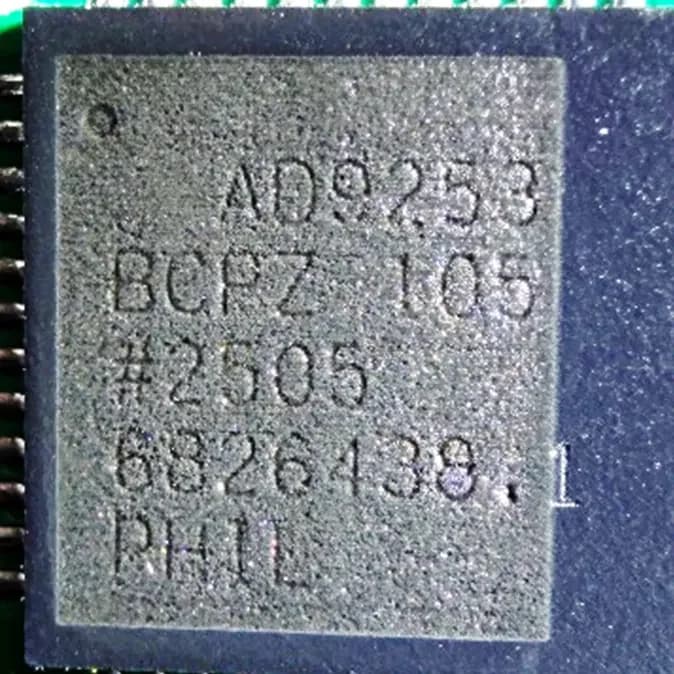
Even this military component runs on Western chips. A Kometa-M12 recovered from an Izdelie-30 cruise missile contained an Analog Devices AD9253 analogue-to-digital converter with a date code from the fifth week of 2025. Ukraine’s intelligence has also published the Russian suppliers that feed base modules to VNIIR-Progress.
The US Treasury designated JSC VNIIR-Progress on 16 November 2023. The UK followed on 13 June 2024, and Japan added the company and its chief executive on 2 October 2026. None of that has stopped the antenna from appearing in weapons built in 2025 and 2026.
Where does the jamming race end?
I expect it to end in a stalemate on satellite navigation and a shift away from it. Each Kometa version adds antenna elements and processing; each Ukrainian jammer answers with more power or new tactics. Neither side can win that cheaply, so both are moving to navigation that does not need a satellite signal at all: inertial units, terrain and visual matching, and onboard processing that recognises the target. Russia's newer weapons already combine Kometa with inertial navigation and mesh radios, as the Geran-5 shows. The newest version, the Geran-5 K5, adds a camera that matches the ground below to stored maps, as I describe in the Geran-5 K5 and Susanin navigation.
The next generation, as I see it, navigates and homes optically: a camera, a model trained to fly by what it sees, and terminal guidance that needs no signal from outside. Several Ukrainian drones already work this way. Beyond that is autonomy in the full sense: the operator sets the target, and the drones choose the tactic, pass information to each other and pick the targets themselves. What is sold as AI today is mostly algorithms; that step will be the real one.
For the West the lesson is that anti-jam navigation is now a basic requirement for any drone sold to a military buyer, not an option. The US Blue UAS framework treats navigation and radio components as critical, and a European or American drone that loses its way under jamming will not survive its first test in Ukraine. Western guided weapons learned it the hard way: JDAM-ER bombs and Excalibur shells missed under Russian jamming that their receivers had been designed to resist.
Signals worth watching: new Kometa variants with more elements, Russian weapons recovered with visual or terrain navigation, and Western buyers writing jamming resistance into their requirements.
What will the market need next?
Kometa shows that anti-jam navigation has become a component market of its own. Every Western drone that wants to survive its first test in Ukraine needs an anti-jam antenna, and the US Blue UAS framework treats navigation and radio parts as critical components that cannot come from China. Western makers of controlled-reception antennas small and cheap enough for a small drone are few, and drone companies will compete for their output.
The next market is the step after the antenna. Navigation that does not need a satellite at all, visual and terrain matching and better inertial units, is where both sides are heading, and the buyers include artillery programmes as well as drone makers: the US Army is already upgrading its Excalibur guided shells for GPS-contested conditions.
The jamming side has demand too. Jammers that can defeat a multi-element antenna are a product Ukraine needs against Russian weapons, and their makers sell to every army that may face the same antennas.
Signals worth watching: anti-jam antenna makers on the Blue UAS framework list, contracts for GPS-free navigation in drones and munitions, and recovered Russian weapons with visual or terrain navigation.
What it means for a founder
Two things. First, in electronic warfare every advantage is temporary, and the product that wins is the one that iterates fastest: Kometa went from four elements to sixteen in a few years because each Ukrainian jammer generation forced a new one. Anyone building navigation, jamming or counter-drone systems should plan a product line, not a product. Second, the same chips keep turning up inside the most important parts. For a sanctions enforcer, a single ADC with a 2025 date code inside a military antenna is a more useful lead than a list of a thousand components, the same lesson as the Banderol’s bill of materials. What that means for defenders as production grows is in the risks at 80, 150 and 400 a month.
Sources (8)
- Ukraine Defence Intelligence, War & Sanctions: companies producing jamming-resistant CRPA antennas
- Ukraine Defence Intelligence, War & Sanctions: VNIIR-Progress products
- Defence Ukraine, Kometa CRPA and jamming resistance, 2026
- Defence Ukraine, the Russian FAB and UMPK glide bomb in 2026
- US Treasury, sanctions designations including JSC VNIIR-Progress, 16 November 2023
- UK government, Russia sanctions notice, 13 June 2024
- TASS, Japan sanctions Russian companies and individuals, 2 October 2026
- Forbes, Ukrainian lives hang on a deadly electronic warfare arms race, 27 March 2025