
Ruta is a cruise missile sold as a factory, and the Dutch order of 700 puts its price near 357,000 euros while nobody has audited either number
Ruta is the low-cost cruise missile from Destinus, a company with Dutch venture money founded by a Russian-born entrepreneur; Ukraine counts it as a Ukrainian system. The Netherlands is paying for about 700 for Ukraine, Destinus says it has built 1,750, and on 17 November 2026 it claimed seven Ruta brought down a span of the Kerch Bridge, a claim the SSU's account does not match. I go through the blocks, the arithmetic and the discrepancy.
On 17 November 2026 Destinus, the company behind the missile, posted a short statement: "Today, seven RUTA missiles hit the bridge, causing one span to collapse." The bridge was the Kerch (Crimean) Bridge, which Russia built to link its mainland to occupied Crimea. Ukraine's own account of that night credits a different weapon with the road span, and that gap between a manufacturer's claim and an official one is where this page begins.
The Ruta cruise missile is what the claim was about. It is a small jet missile, financed with Dutch money and counted by Ukraine among the Ukrainian weapons used against the bridge. Ukraine has been fighting Russia's full-scale invasion since February 2022. The operation itself is in the Kerch Bridge article.
My argument is that Ruta is best read as a factory with a missile on top. The engine is Destinus's own, and the headline numbers describe output and price, which is why they need an auditor more than a specification does.
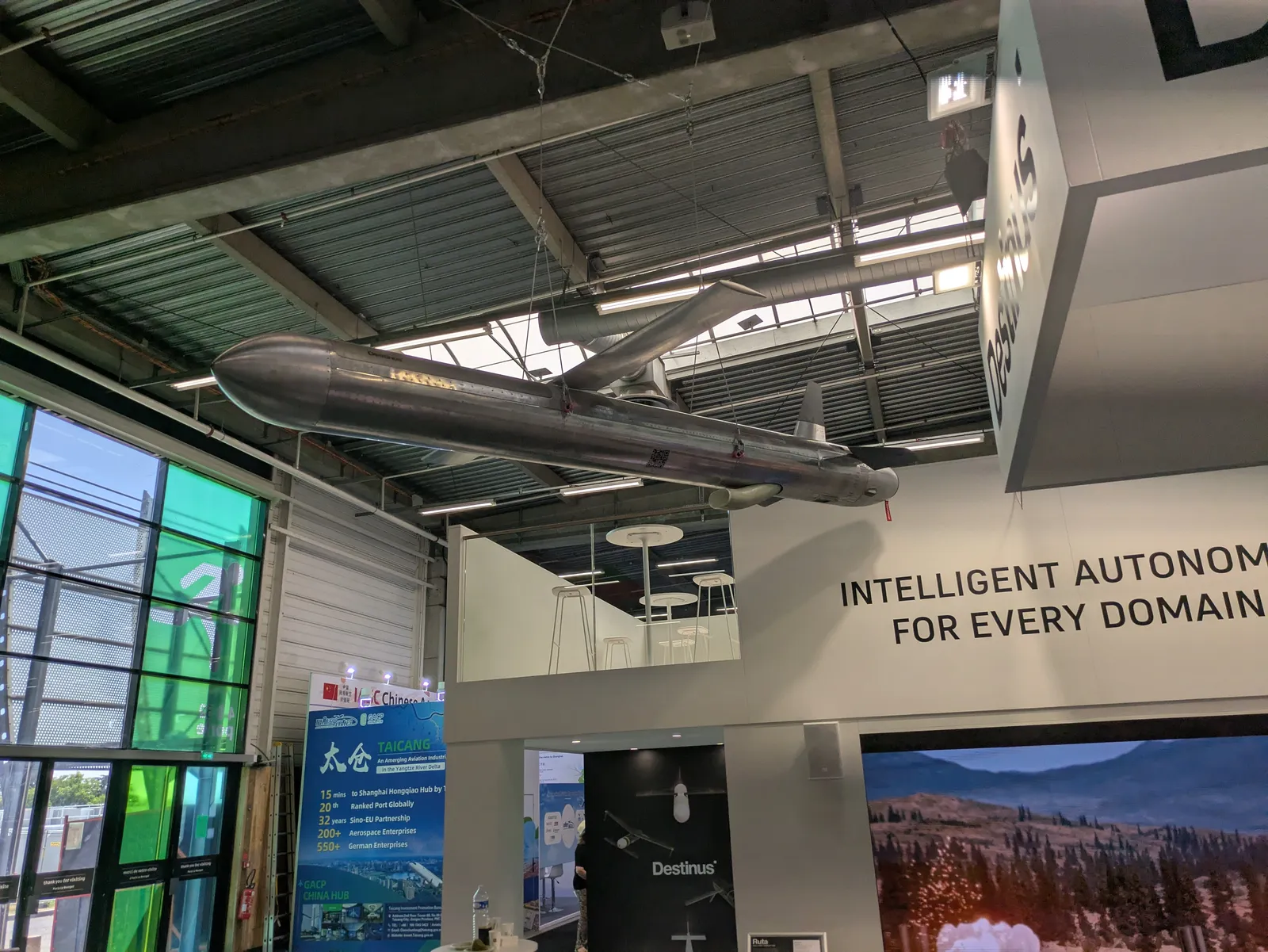
Ruta in numbers
| Block 1 | Block 2 | Block 3 | |
|---|---|---|---|
| Status | in production, per Destinus | unveiled 15 January 2026; flight-tested in Ukraine in April 2026 | in development with Rheinmetall |
| Range | over 300 km | 420 km to over 700 km, depending on the outlet | 2,000 km planned |
| Warhead or payload | payload up to 150 kg (one outlet says a warhead of about 100 kg) | 250 kg | 250 kg planned |
| Speed | Mach 0.8, per partner Oesía | 600 to 700 km/h | not published |
| Engine | T150 turbojet, 150 kgf thrust | the same T150 | a new, larger engine |
| Size | 3.93 m long, 2.25 m wingspan, takeoff mass up to 300 kg | larger, folding wings | not published |
| Guidance | accuracy of 15 m claimed by partner Oesía; navigation not published | AI-assisted electro-optical and infrared seeker | not published |
| Launch | booster, from an open rail | booster, from a canister or a 40-foot container | not published |
Two cautions on the table. The 150 kg figure is a payload, not necessarily a warhead, and a Ukrainian outlet's July 2026 article put the Block 1 warhead at about 100 kg. For Block 2, Army Recognition reported more than 450 km at the January unveiling, Militarnyi gave up to 420 km, and the Netherlands order was reported with more than 700 km. All of these come from the maker or partners. I use ranges because I cannot reduce them to one.
Who is Destinus?
Mikhail Kokorich founded it in 2021. He is Russian-born, earlier founded the space companies Dauria Aerospace and Momentus, and told the French magazine Challenges in January 2024 that he had given up his Russian citizenship because of the invasion. The company started in Switzerland, moved its headquarters to the Netherlands in November 2024, and now makes Ruta in Hengelo, with sites also in Germany, Spain and Ukraine.
The business is more interesting than the origin. Kokorich said in 2024 that Destinus had delivered "hundreds" of low-cost drones to Ukraine by then and that Ukraine was one of its main customers, and that development of Ruta began in the second half of 2023. It reportedly has raised close to 400 million euros, was seeking 200 million more before a stock listing, as reported in May 2026, and in April 2026 formed a joint venture with Rheinmetall, the German arms maker, to build cruise missiles and rocket artillery. In October 2026 it announced a partnership with the German AI defense company Helsing. These are press reports of the company's fundraising, not audited accounts.
How is Ruta used, and where did it first fly?
Zelensky announced the first combat use in October 2025, an attack on an offshore platform, as Militarnyi, a Ukrainian defense outlet, reported. In July 2026 Russian channels posted tail wreckage that Militarnyi matched to a Block 1. Destinus now says its missiles have been used by Ukrainian forces "on numerous occasions", including against bridges the Russian army uses.
Block 1 is built for fixed, valuable targets: a depot, a command post, a radar. Block 2, with a 250 kg payload and a seeker that looks at the target, is intended for hardened ones.
What does the Dutch order say?
In mid-June 2026 Ukraine's Mykhailo Fedorov announced that the Netherlands would pay for about 700 Ruta, produced in the Netherlands. On 25 June, the Dutch newspaper NRC was reported as putting the deal at 250 million euros for 700 Block 2 missiles, inside a 500 million euro Dutch package for Ukraine in which half goes to drones and missiles from Dutch makers.
Divide 250 million by 700 and each missile costs about 357,000 euros. That is my arithmetic and a Ukrainian analysis site did the same; there is no official unit price. It also depends on what the 700 are. Defense Express, a Ukrainian defense outlet, thought Block 1 or a mix was possible, because the variant was never confirmed, and no Dutch record had verified the count.
Accept the sum for a moment, and the per-kilogram arithmetic is striking. If all 700 are Block 2 with a 250 kg payload, a missile costs about 1,430 euros per kilogram of payload. In the Barracuda page I put Anduril's missile at $3,300 to $4,400 and the Tomahawk at about $8,100. At any plausible exchange rate, Ruta Block 2 would be under half the Barracuda and about a fifth of the Tomahawk. If the order is Block 1 at 150 kg, it is about 2,380 euros per kilogram, still the lowest of the three, before anyone counts how many arrive.
What does 1,750 built actually count?
On 29 October 2026 Destinus said it had completed 1,750 Ruta Block 1 missiles, at a rate close to 300 a month. The word "completed" is not defined. The statement names no buyer, no delivery and no factory, and as of early November no government or auditor had confirmed or contradicted it. When Reuters reworded "completed" as "built", the analysts at defenceukraine.com called it drift. In April Rheinmetall had described Destinus as producing "over 2,000 cruise missile systems a year", which covers a broader family. In June Destinus marked its 1,000th T150 engine, which is a measure of capacity.
I read these numbers as the position of a company raising money before a stock listing, which is why a government order with a contract and deliveries will tell a buyer more than any press release.
What did Ruta do at the Kerch Bridge?
Four accounts do not agree.
- Destinus: missiles damaged the bridge's upper load-bearing structure the first night, and on the second day seven Ruta hit it and one span collapsed.
- The SSU, Ukraine's security service: its Alpha special forces used Palianytsia missile-drones against the road section, and after that the road span fell into the water.
- Zelensky: Ruta drones were among the weapons that hit the railway section, with Neptune and the FP-5 Flamingo. He did not say what brought the span down.
- The General Staff: the railway section is standing, with a damaged arch.
Destinus did not say which block, did not give the first night's count, and described its own weapon as a missile where Zelensky said drones. None of this makes Destinus wrong. The accounts may describe different parts of one bridge, and an operation with 11 weapons has more than one author. What it shows is that a manufacturer's post on the day is a marketing event, and the official damage assessment is another document.
One piece of arithmetic is worth having, with its limits. Seven Block 1 missiles at 150 kg is about 1,050 kg of payload, close to the roughly 1,100 kg that TWZ gives for a single Flamingo warhead. If they were Block 2, it is 1,750 kg. That is nominal payload, and no source says where each missile struck. I come back to this in the Neptune page, because the same salvo logic applies to the rail section.
Where does Ruta go next?
Over the next two years I expect Ruta's value to come from three events, and each can be checked.
- A contract with a unit price. If a government publishes a price near 350,000 euros for Block 2, the economics above hold. If the price is nearer a million, Ruta is a good missile at a normal price.
- Block 2 in numbers. Block 2 was flight-tested in Ukraine in April 2026; the first deliveries of the 700 will show whether the line works.
- Block 3 with Rheinmetall. A 2,000 km missile brings in a different customer, Germany and NATO as well as Ukraine. Flight tests are expected next year.
What will the market need next?
- Small turbojets. The T150 produces 150 kgf of thrust. Destinus makes its own; the makers that buy theirs face the shortage I describe in the interceptor-drone engine bottleneck. A second European maker of engines this size is a product with a ready buyer.
- Seekers that choose a target. An AI-assisted infrared seeker at the price of a missile that costs a few hundred thousand euros, with a library of Russian air defense, bridges and aircraft.
- Warheads and explosive fill. A missile built by the thousand needs a warhead supply of the same size. European explosive capacity is already tight: Denmark's propellant production is delayed to late 2027, as I cover in the Western money page.
- Launchers and containers. Block 2 fires from a 40-foot container. The integrator who fits it to existing trucks and ships sells to every buyer of the missile.
- Acceptance testing. If 300 a month is real, someone must test them. A range and a test service priced per round, with a certificate a ministry accepts, is a business.
What Ruta means for a defense founder
- Your claim is read against the official one. Destinus's bridge statement was reported everywhere, as a claim. If your number can be checked against a customer's, give the customer's.
- Define the word. "Completed", "built" and "capacity" are three different numbers. A buyer or investor will ask which one, and the answer decides the valuation.
- Be the second source. Destinus builds its engine. The supplier that can offer a qualified alternative for the seeker, the fuze or the booster sells into a program that a government is financing.
- Follow the budget line. The Dutch order sits inside a package for Ukraine; European governments are paying for missiles on Dutch and German soil. Know which package a customer is spending, because the rules for who can be paid come with it.
Sources (13)
- Militarnyi, Ruta missiles and Da Vinci drones: Destinus reveals details of strikes on Crimean Bridge, 17 November 2026
- Defence Industry Europe, Destinus says seven Ruta cruise missiles hit the Kerch Bridge, 17 November 2026
- UNITED24 Media, Europe's Ruta missiles hit Crimean Bridge seven times, manufacturer says, 17 November 2026
- TWZ, What we know about Ukraine's strikes that cut Russia's Kerch Bridge road vehicle span, 17 November 2026
- The Defense News, Netherlands orders 700 Ruta Block 2 cruise missiles for Ukraine in a 250 million euro deal, citing NRC, 25 June 2026
- Militarnyi, Netherlands will fund production of new Ruta rockets for Ukraine, 19 June 2026
- Defence Express (defence-ua.com), How much might Ruta cruise missile cost, 27 June 2026
- defenceukraine.com, Destinus's 1,750 Ruta claim and what it counts, November 2026
- Army Recognition, Destinus unveils Ruta Block 2 cruise missile, January 2026
- Militarnyi, Ruta missiles strike Russian targets, debris shown for the first time, 24 July 2026
- Kyiv Post, Russian dissident's Swiss start-up has secretly supplied Ukraine with military drones, 2 February 2024
- The Next Web, Destinus is raising 200 million euros ahead of an IPO, May 2026
- NAVAIR, Tomahawk product page, unit cost
Where this comes up on the site
- The Da Vinci drone is one of the least documented weapons on Zelensky's Kerch Bridge list, and by its maker's account the one that worked before the bridge was touched
- Ukraine spent a month taking apart the Crimean Bridge's defenses, then hit one arch two nights running. How eleven Ukrainian weapons dropped the span
- Palianytsia is the weapon the SSU credits with dropping the Kerch Bridge span, and its limit is the Czech-Ukrainian engine rather than the warhead