
IRIS-T and the factory limit of Western air defense: why the system that works is the one you cannot get
IRIS-T SLM is the German medium-range air defense system that has protected Ukrainian cities since 2022. Diehl Defence says it intercepts more than 95% of targets. Here is what it is, the numbers, how many Ukraine has, and why production, not performance, is the limit.
IRIS-T SLM is a ground-based, medium-range air defense system built by Germany's Diehl Defence, and it is one of the systems Ukraine relies on to protect its cities from Russian missiles and drones. A fire unit consists of a launcher, a radar and a tactical operations center, with support vehicles, and it fires IRIS-T missiles derived from the air-to-air missile of the same name. It is designed to engage aircraft, helicopters, cruise missiles and drones at a range of up to 40 km and an altitude of up to 20 km. Diehl says its interception rate in Ukraine is above 95%.
My argument is that IRIS-T shows the real limit of Western air defense: not technology but factories. The system works well enough that everyone wants it, and Diehl cannot build it fast enough. A weapon can be a technical success and a strategic bottleneck at the same time.
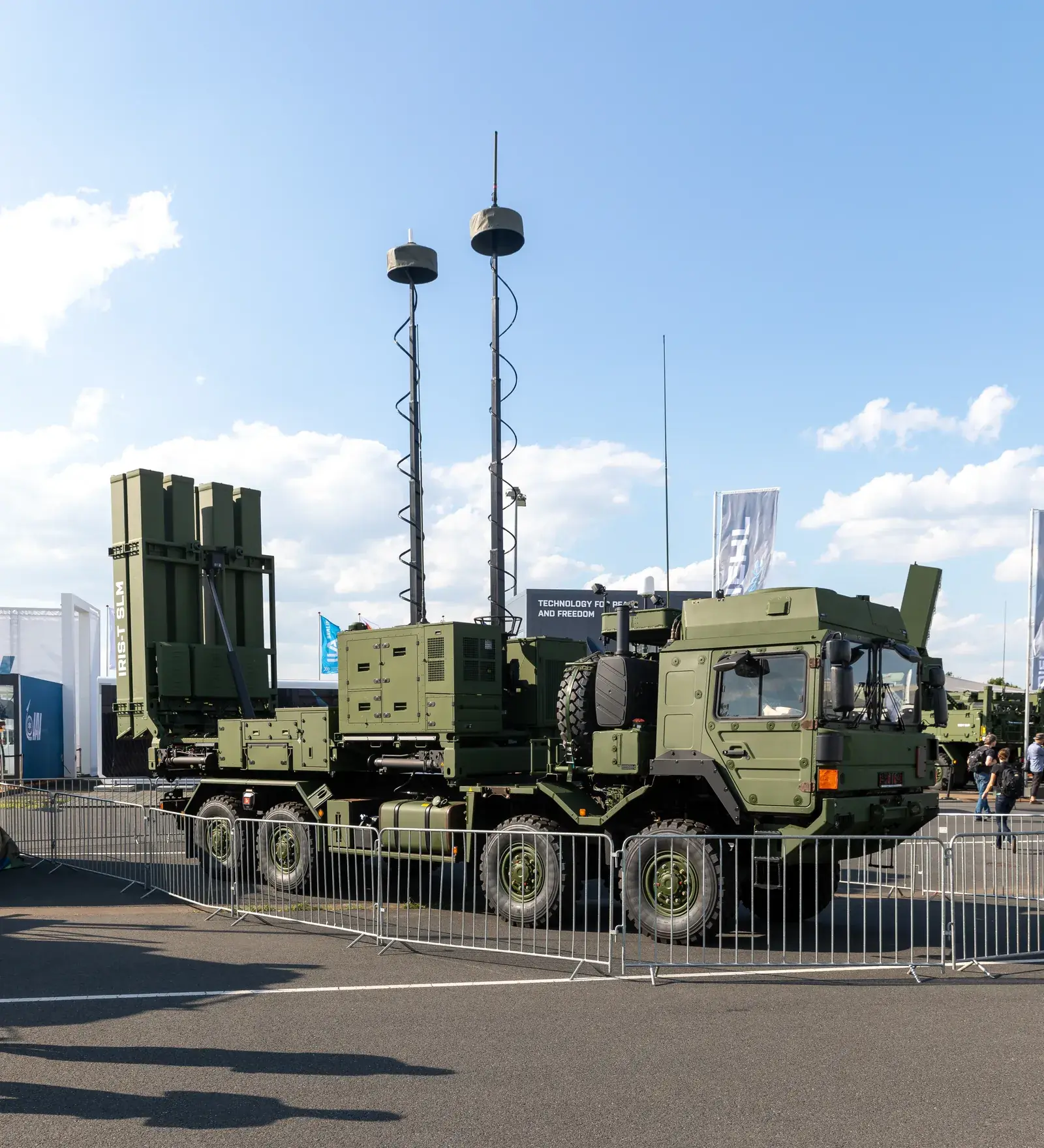
The family
| Version | Role | Range / altitude | Status |
|---|---|---|---|
| IRIS-T SLS | short range | 12 km / 6 km | in service |
| IRIS-T SLM | medium range | 40 km / 20 km | in service, the version Ukraine relies on |
| IRIS-T SLX | longer range | up to 80 km / above 25 km | in development |
One SLM fire unit can carry up to eight launchers, so launcher counts and fire-unit counts are not the same number.
How many does Ukraine have?
Ukraine's Ministry of Defence counted nine IRIS-T systems guarding the country in December 2025. Defense Express reported an eleventh SLM fire unit operational in early October 2026, a figure not confirmed by an official source, and its count of this year's deliveries is not consistent. German aid packages have kept adding missiles and units; what Germany's latest money buys is in German-Ukrainian defense joint ventures. NATO countries are buying too: Diehl delivered Estonia's first fire unit in June 2026, and Switzerland and Slovenia have ordered more under the European Sky Shield Initiative.
What does it cost?
No list price is published. Germany's order of six systems in 2023 was reported by Reuters at about €950 million, roughly €158 million per system with support and training included. Every IRIS-T missile spent on a cheap drone is one fewer for a cruise missile, which is why cheaper layers matter around it; the arithmetic is in cost-exchange ratio.
Why are there never enough?
Because the factory sets the number. Diehl's chief executive told Reuters in January 2026 that the company could build about ten fire units a year, rising to up to sixteen about two years later, and that missile output had grown about tenfold since 2021, without giving an absolute figure. In January 2026 Diehl opened a 3,400 m² missile integration building at Nonnweiler, with three more buildings under construction. In my reading, demand from Ukraine and from Europe's own rearmament outruns that, which is the gap that cheaper layers and new programmes such as FREYJA are meant to fill.
Where does this go?
I expect demand for IRIS-T and systems like it to outrun supply for years, and three responses to follow.
- More factories, more licences. Diehl's expansion to up to sixteen fire units a year is a start. The faster route is licensed or joint production in other countries, including, if the reported agreements on missiles develop, in Ukraine itself.
- A protective layer around it. Every IRIS-T missile saved from a cheap drone is one available for a cruise missile. Interceptor drones, guns and lasers become the way to stretch a scarce system, and their buyers will justify them that way.
- Price becomes negotiable. Scarcity keeps prices high today. Once several production lines run, the buyer's question shifts from delivery dates to cost per engagement, which is where newer, cheaper interceptors will compete.
Signals worth watching: Diehl's delivered fire units per year, any licensed production abroad, and the number of IRIS-T missiles ordered against the number of fire units.
What will the market need next?
A system that everyone wants and one company cannot build fast enough creates a supplier market. Diehl's growth from about ten to up to sixteen fire units a year needs subcontractors for missile parts, launchers, radars and vehicles, qualified to Diehl's standards, and most of the bottleneck sits in the missile. European companies that can add capacity for motors, seekers and electronics have a buyer with a backlog.
The second market is the layer that saves IRIS-T missiles. Every IRIS-T missile fired at a cheap drone is one fewer for a Russian cruise missile aimed at a Ukrainian city, so interceptor drones, guns and lasers are bought to protect the expensive system's stock, and buyers will justify them that way.
Licensed production abroad is the third. If agreements to build IRIS-T missiles in other countries, Ukraine among them, develop, those lines will need local suppliers, quality systems and trained staff from the start.
Signals worth watching: Diehl's delivered fire units each year, licensed production agreements, and orders for cheap layers placed alongside IRIS-T purchases.
What does IRIS-T mean for a supplier?
- Capacity is the product. A buyer of IRIS-T is waiting in a queue. A supplier who can shorten Diehl's lead time on a component, from rocket motors to electronics, is selling into the bottleneck.
- Cheaper layers around it are the opening. Interceptor drones, guns and lasers protect IRIS-T missiles from being spent on cheap targets; see the jet Shahed and the counter-drone directed energy pilot.
- European money is attached. Systems like IRIS-T are what governments buy with EU defence loans; the rules for a company are in SAFE and EDIP.
Sources (10)
- Diehl Defence, Latvia orders IRIS-T SLM (40 km range, 20 km altitude), December 2023
- Diehl Defence, air defence systems (SLS)
- Diehl Defence, evolution of IRIS-T (SLX)
- Diehl Defence, first IRIS-T SLM fire unit delivered to Estonia (over 95%), June 2026
- Diehl Defence, new production building at Nonnweiler, January 2026
- Ministry of Defence of Ukraine, nine IRIS-T systems guarding Ukraine's skies, December 2025
- Defense Express, Ukraine gets 11th IRIS-T SLM, October 2026
- Reuters, Diehl to boost production of IRIS-T, CEO says, 22 January 2026
- Reuters, Germany to buy six IRIS-T air defence units, June 2023
- Diehl Defence, armasuisse procures IRIS-T SLM
Where this comes up on the site
- Russia's bridge-strike salvos are built so that the cheapest missile buys the most expensive response, and one bridge can take 8% of a year's Patriot output
- NASAMS fires a fighter jet's missile from the ground, and that is both why it spread so fast and why it runs short
- SAMP/T is Europe's only answer to Patriot against ballistic missiles, and the limit is how many Asters Europe can build