
NASAMS fires a fighter jet's missile from the ground, and that is both why it spread so fast and why it runs short
NASAMS is the Norwegian-American medium-range air defense system that has protected Ukrainian cities from cruise missiles and drones since 2022. It fires the AIM-120 AMRAAM, the same missile as an F-16. This page explains how it works, why it cannot stop a ballistic missile, what each shot costs against a Shahed, and why its future is the launcher, not the missile.
For about three weeks from late November 2025, Ukraine's F-16 squadron had only a handful of American air-to-air missiles left, and pilots flew daytime sorties against Russian drones with their cannons. The same shortage cut into the work of Ukraine's NASAMS batteries on the ground, Reuters reported, because they fire the same missiles. Since Russia launched its full-scale invasion of Ukraine in February 2022, NASAMS has defended Ukrainian cities against cruise missiles and drones, and it shares its ammunition with an air force.
My argument is that NASAMS's design choice decides both its success and its limit. It took a missile NATO already had in its stocks, the AIM-120 AMRAAM, and put it on a truck. That let it reach Ukraine quickly and draw on a missile NATO already produced for its aircraft, and it makes every shot a draw on the same stock the fighters need. Norway's work to load it with Ukrainian-made missiles shows where its lasting value sits: the radar, the fire control and the launcher, open to any missile that fits.
What is NASAMS?
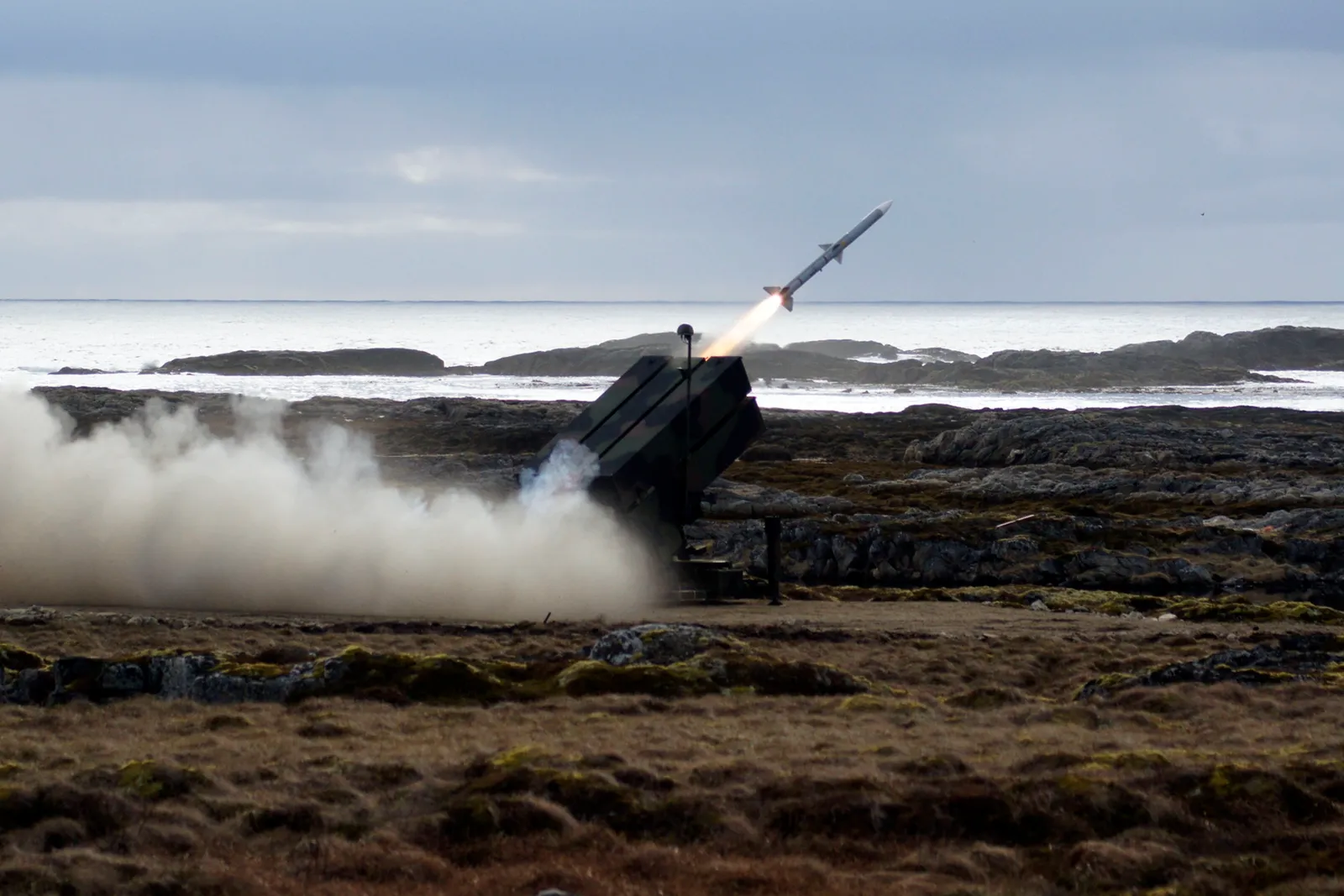
NASAMS, the National Advanced Surface-to-Air Missile System, is a medium-range ground-based air defense system developed by Kongsberg of Norway and Raytheon, now part of RTX. A battery combines Raytheon's AN/MPQ-64 Sentinel radar, Kongsberg's Fire Distribution Center, which runs the engagement, and canister launchers on trucks, each carrying six missiles. Its main missile is the AIM-120 AMRAAM, the radar-guided air-to-air missile that arms the F-16, F-35 and most NATO fighters, fired without special modification. Newer versions also fire the longer-range AMRAAM-ER and the short-range infrared AIM-9X Sidewinder.
It has defended Washington, D.C. since the mid-2000s, and Denmark and Taiwan both ordered it in 2025. Ukraine received its first two batteries in November 2022, and that month the US Army signed a $1.2 billion contract for six more.
NASAMS in numbers
| Figure | Value |
|---|---|
| Makers | Kongsberg (Norway), Raytheon (RTX, United States) |
| Components | AN/MPQ-64 Sentinel radar, Fire Distribution Center, launchers of 6 missiles |
| Missiles | AIM-120 AMRAAM, AMRAAM-ER, AIM-9X |
| Reach with AMRAAM | about 30 km and up to 16 km altitude |
| Targets | cruise missiles, aircraft, helicopters, drones; not used against ballistic missiles in Ukraine |
| Missile price | more than $1 million per AIM-120, as Reuters reported |
| Battery price | $1.2 billion for six batteries for Ukraine (US Army, November 2022), about $200 million each with support |
| AMRAAM output | target of at least 1,900 a year under a February 2026 framework; a five-year contract worth up to $20.7 billion in September 2026 |
Why can NASAMS not stop an Iskander?
Because it was designed for targets that fly through the air, not ones that fall through it. A cruise missile or a Shahed flies low and level at a few hundred kilometres an hour or at airliner speed, and an AMRAAM can turn onto it and explode its warhead close by. A ballistic missile such as the Russian Iskander-M comes down almost vertically from 50 km or more at 700 to 800 metres a second, and manoeuvres in the last seconds. My reading of why: the target spends little time inside the AMRAAM's envelope, which tops out about 16 km up, and a proximity blast built to shred an aircraft is not designed to destroy a heavy warhead body falling that fast. Patriot's PAC-3 MSE and the newest Aster are built to hit it directly.
Ukraine's Air Force said as much in March 2023, when it listed the Iskander-M among the missiles its systems of that time could not intercept. RUSI, the London defense think tank, still counted NASAMS in July 2026 with Germany's IRIS-T as the cruise-missile layer of Ukraine's defense, with Patriot and the Franco-Italian SAMP/T as the only effective answer to ballistic missiles.
That is why NASAMS does not appear in the ballistic waves of the bridge strikes I break down in Russia's bridge-strike salvos. It matters in the same raids anyway. Russia sends hundreds of drones and cruise missiles with the ballistic missiles, and every one that NASAMS or IRIS-T stops is one that Patriot does not have to.
What does a NASAMS shot cost against a drone?
More than $1 million for an AIM-120, against $35,000 to $50,000 for a Shahed, the Iranian-designed attack drone Russia produces as Geran-2. That is a loss of twenty to thirty to one even when the missile hits, which is the cost-exchange ratio problem in its plainest form. Two sources told Reuters in March 2026 that the AIM-120 is too expensive to fire in volume at mass-produced drones.
The loss is not only in dollars. An AMRAAM fired at a Shahed over Kyiv is one fewer for an F-16 intercepting a cruise missile, and one fewer in the stocks of every NATO air force that would have to fight with the same missile. Ukraine has moved much of the drone defense to cheaper weapons: interceptor drones priced in the low thousands of dollars, which by spring 2026 accounted for about 40% of Shahed shootdowns, plus mobile gun teams and electronic warfare. That leaves the expensive missiles for cruise missiles and fast jet-powered drones.
Why is Norway putting Ukrainian missiles into it?
Because the launcher and the fire control are worth more than the missile they were built around. In January 2026 Norway's foreign minister, Espen Barth Eide, said in Kyiv that Norway was working to integrate Ukrainian-made interceptors into NASAMS without changing its radar, command or launcher architecture. No missile has been selected. Secondary reporting names possible candidates: rounds derived from the Soviet-era R-73 and R-27 air-to-air missiles, Ukraine's UP-277, and interceptor drones for cheap targets. The goal is a missile that can be made in larger numbers at a lower price.
That is the real lesson of NASAMS for anyone who builds air defense. It spread because it was open to a missile that already existed. Its next step is openness to missiles that do not depend on one American production line. Ukraine's president spoke in August 2025 of joint NASAMS production in Ukraine with Norway, and Kongsberg has committed nearly three billion kroner to expand its own air defense and missile production.
Where does NASAMS go next?
I expect it to become a multi-missile platform, with AMRAAM at the top of a menu of cheaper rounds. Four signals will show it.
- The first Ukrainian missile fired from a NASAMS launcher. That would put a Ukrainian-built round into a NATO-standard system already in service across Europe, and test whether open launchers can break a single-supplier missile market.
- AMRAAM output against the 1,900-a-year target. Every increase eases the competition between fighters and ground batteries.
- New buyers on NATO's eastern flank. Denmark included NASAMS in its 2025 air defense package; the Pentagon awarded a contract of about $699 million for Taiwan's systems in November 2025. Each order adds demand to the same missile line.
- Cheaper effectors from the same launcher. Any contract for a non-AMRAAM round in NASAMS, from Kongsberg or anyone else.
What will the market need next?
- A cheaper missile for the NASAMS launcher. Every NASAMS battery in service is a launcher looking for a round cheaper than $1 million for targets that do not need an AMRAAM. Norway's integration programme shows the buyer is willing. I expect the winning price in the low hundreds of thousands of dollars: far enough below a $1 million AMRAAM to change the arithmetic, for targets harder than a $35,000 to $50,000 Shahed.
- Integration of new effectors into the Fire Distribution Center. Interceptor drones, guns and lasers cued by the same radar and fire control. The buyer is every NASAMS operator; the product is software, interfaces and certification, and the hard part is Kongsberg's cooperation.
- AMRAAM supply chain capacity. Rocket motors, seekers and electronics for a line targeted at 1,900 missiles a year or more. A $20.7 billion multi-year contract pays the suppliers who can add capacity on time.
- Sensors that sort cheap targets from expensive ones. A radar track that tells a decoy from a Shahed and a Shahed from a cruise missile decides which weapon fires. That classification is worth more as the menu of effectors grows.
What NASAMS means for a defense founder
- Build to fit what is already there. NASAMS spread because it used a missile already in NATO's stocks. A new interceptor, sensor or software that fits an existing launcher and command system reaches a buyer years faster than one that needs its own.
- The launcher is a platform. Norway is opening NASAMS to new missiles. A founder with a cheap effector should talk to the system owner before the customer.
- Price per intercept is the pitch. Every NASAMS buyer compares a new round with a $1 million AMRAAM and a $35,000 Shahed. Make that comparison for them.
Sources (13)
- Reuters via The Star, Ukraine's F-16 jets were starved of US-made missiles for weeks, 5 March 2026
- Euromaidan Press, Ukraine kept the F-16 missile shortage secret for months, 5 March 2026
- The War Zone, The common missile NASAMS uses is its biggest advantage for Ukraine, 13 October 2022
- Defense Daily, Raytheon awarded $1.2 billion deal to deliver six more NASAMS for Ukraine, 30 November 2022
- Army Recognition, Norway to integrate Ukrainian missiles into NASAMS, 13 January 2026
- Ukrainska Pravda, Air Force specifies which missiles can and cannot be shot down, 16 March 2023
- RUSI, Four years on: an update on the air war over Ukraine, 28 July 2026
- RTX, Fast track: critical munitions agreements, 4 February 2026
- RTX, Raytheon awarded $20.7 billion multi-year contract for AMRAAM, 28 September 2026
- Institute for Science and International Security, updated analysis of Shahed-type UAV deployment against Ukraine, May 2026
- Kongsberg, Norway acquires new NASAMS air defence systems, 2 February 2024
- Defense News, Denmark picks French-Italian SAMP/T air defense system over Patriot (NASAMS in the package), 12 September 2025
- Al Jazeera, US sells $700m NASAMS missile system to Taiwan, 19 November 2025