
JDAM-ER in Ukraine: why a cheap guidance kit mattered more than the bomb, and what Russian jamming exposed
JDAM-ER is Boeing's guidance kit with wings that turns an unguided bomb into a glide bomb with a range of more than 40 miles. Ukraine has used it on Soviet-era fighters since early 2023. Here is what it is, the two problems it met, and what it says about kits versus complete weapons.
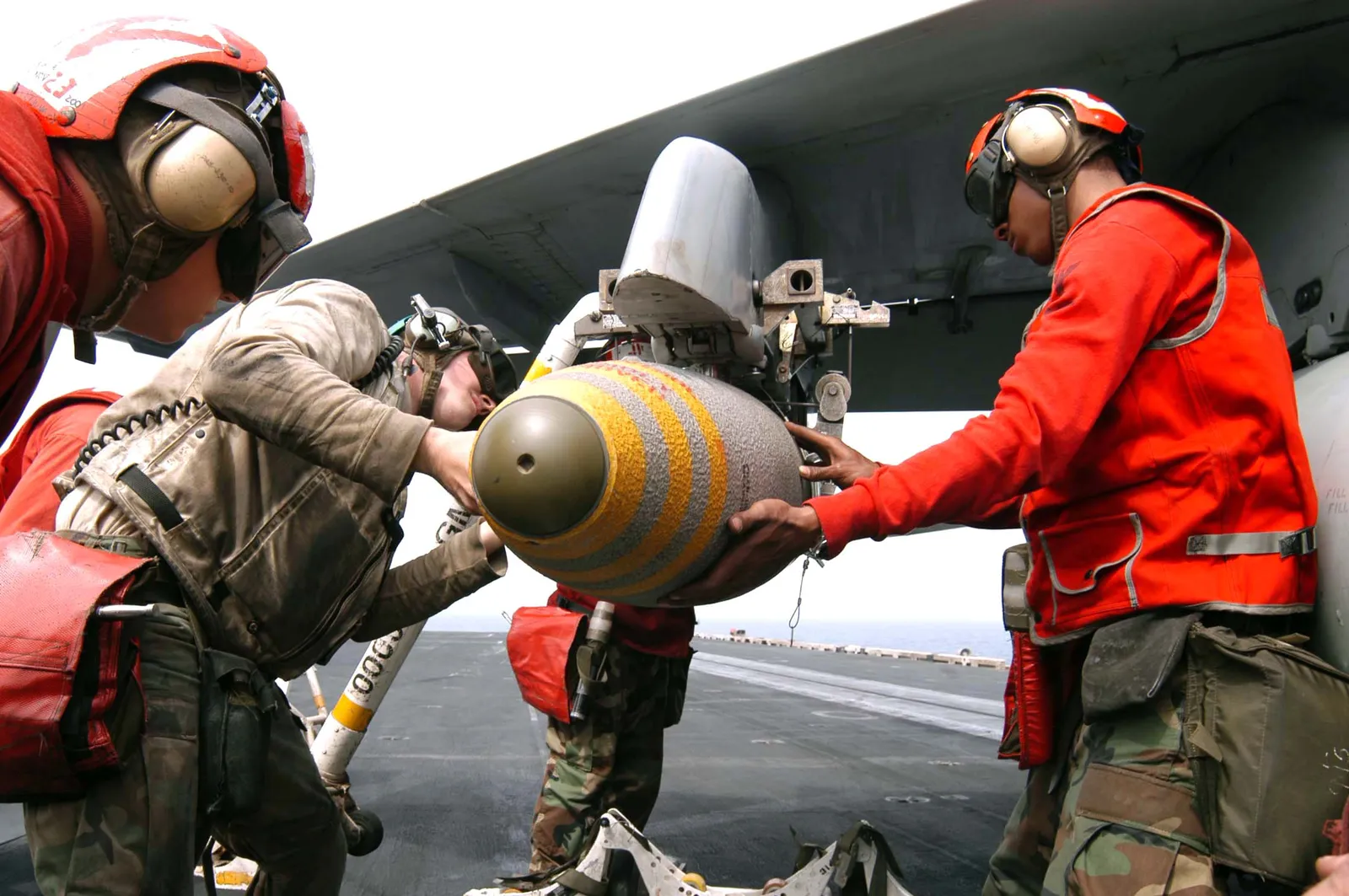
JDAM-ER, the Joint Direct Attack Munition Extended Range, is a Boeing kit that bolts onto an ordinary unguided bomb. The JDAM part adds a tail section with an inertial navigation unit corrected by GPS, which turns the bomb into a precision weapon; the ER part adds a folding wing set that lets the bomb glide, which Boeing says triples its range to more than 40 miles, about 72 km. A US Air Force general confirmed in March 2023 that the kit was operational in Ukraine, which has been defending itself against Russia's full-scale invasion since February 2022, fitted to Soviet-era fighters that were never designed to carry it.
My argument is that JDAM-ER shows the most useful idea in Western military aid: the kit, not the weapon. A kit is cheap, it makes old bombs and old aircraft useful, and it can be produced and changed faster than a missile. Russia drew the same conclusion and turned its own stockpile of unguided bombs into glide bombs that it drops on Ukrainian cities and front-line towns every day. The weakness JDAM-ER revealed in Ukraine, dependence on GPS, is the weakness of the kit idea too, and fixing it is where the next contracts are.
What JDAM-ER is
| Maker | Boeing; JDAM in production since 1998 |
|---|---|
| What it adds | tail kit with GPS-aided inertial guidance; the ER version adds a deployable wing set |
| Range | more than 40 miles (about 72 km) for the ER version, by Boeing; depends on release height and speed |
| Cost | the US Air Force FY2025 request was $125.3 million for 1,500 JDAM kits, about $83,500 each as a programme average, not an ER-specific price |
| In Ukraine | operational from early 2023, on Soviet-era fighters with adapted pylons |
What problems did it meet in Ukraine?
Two separate ones, and they should not be mixed up. Politico reported in April 2023, from a leaked Joint Staff slide and a Defense Department official, that Russian GPS jamming was causing JDAM-ER bombs to miss their targets. The same report said some bombs failed to explode because their fuzes did not arm on release, and that Ukraine's Air Force had fixed that part. Politico could not verify the slide's detailed statistics.
The fuze problem was an integration problem: an American kit on a Soviet aircraft, set up by people learning the system in a war. It was solved by the users. The jamming problem was a design assumption, that the satellite signal would be there, and the users could not solve it alone.
Why does the kit matter more than the bomb?
Because the kit changed what Ukraine's existing air force could do without new aircraft. A fighter that could only drop unguided bombs over the target, inside Russian air defense, could now release a guided bomb tens of kilometres away and turn for home. Russia made the same calculation in the other direction: its glide-bomb kits, fitted to old bombs by the thousand, are now among its main weapons against Ukrainian positions and cities. The kit is the cheapest way to turn a stockpile into a precision arsenal, which is why both sides are building them. The economics behind that, cheap weapons against expensive defenses, are in cost-exchange ratio.
Where does this lead?
I expect three things.
- Kits replace complete weapons for the mass. Range extension, guidance and seekers sold as kits for existing bombs and rockets, made by the thousand, will take more of the budget than new missiles. Ukraine declared its own guided aerial bomb combat-ready in May 2026, as Defense News reported, after years of relying on scarce Western donations such as JDAM-ER.
- Navigation gets hardened. The US Air Force moved JDAM production to receivers built for the jam-resistant military GPS code from FY2024, by its budget documents. Kits will add better inertial units and seekers that find the target themselves, the same direction I describe for drones in Kometa.
- Range goes up with engines. Boeing put a powered JDAM Long Range into initial production in 2026, designed to fly more than 300 nautical miles with a 500-pound payload. The kit is becoming a cheap cruise missile, the market described in FAMM and LCCM.
Signals worth watching: Ukraine's own guided-bomb output, any published hit rate for hardened kits under jamming, and orders for powered kits.
What will the market need next?
Every air force has old bombs and many have old aircraft, and that installed base is the market. Guidance kits, wing kits for range and seekers that turn a stockpile into precision weapons sell faster than new missiles, because they are paid from smaller budgets and need no new aircraft. The integration work is a market of its own: Ukraine fitted American kits to Soviet-era fighters, and air forces flying older or mixed fleets will pay for the same.
Navigation is again the weak point. Kits with jam-resistant receivers, better inertial units and a seeker for the last seconds will replace those that rely on GPS alone, and Ukraine's own guided bomb, combat-ready since May 2026, shows that a country can build the cheaper end of this market itself.
Signals worth watching: orders for powered and extended-range kits, integration contracts for Western munitions on non-Western aircraft, and Ukrainian guided-bomb production.
What JDAM-ER means for a defense founder
- Sell the upgrade, not the platform. Armies have stockpiles and old aircraft. A product that makes them more useful sells faster than a new platform, and the integration problem is solvable, as Ukraine's air force showed.
- Separate the failures. When a product fails in the field, find out whether it is integration, which the user can fix with you, or design, which only you can fix. Mixing them wastes a year.
- Test where the jamming is. A navigation claim not tested under real electronic warfare is a promise. The route is in how to get a drone tested in Ukraine, and the pattern across Western weapons is in why Western weapons stumbled in Ukraine.
Sources (8)
- Boeing, JDAM product card
- Boeing, Laser JDAM and ER wing kit product card
- US Air Force, FY2025 ammunition procurement budget (JDAM line)
- The War Zone, winged JDAM smart bombs now operational in Ukraine, 6 March 2023
- Politico, Russia jamming US smart bombs in Ukraine, leaked docs say, 12 April 2023
- US Air Force, FY2027 aircraft and ammunition procurement budget (SABR-M transition)
- Boeing, JDAM Long Range enters initial production, August 2026
- Defense News, Ukraine declares its first homegrown guided aerial bomb combat-ready, 18 May 2026
Where this comes up on the site
- Western weapons in Ukraine did not fail because they were bad. They failed where they had never been tested against Russian jamming and drones.
- The Excalibur shell in Ukraine: a precision weapon that lost to a jammer, and what that says about buying precision
- The Archer artillery system: in a war watched by drones, the seconds spent in position matter more than the range