
North Korea's KN-23 is using Russia's war on Ukraine as a test range, and every strike on a Ukrainian city tells Pyongyang how to make the next missile better
The KN-23 is North Korea's short-range ballistic missile, and since the end of 2023 Russia has fired it at Ukrainian cities. This page explains what it is, why its accuracy improved from kilometres to about a hundred metres in a year, whose electronics were found inside it, how many Russia has received, and why North Korean missile crews are now based in Russia.
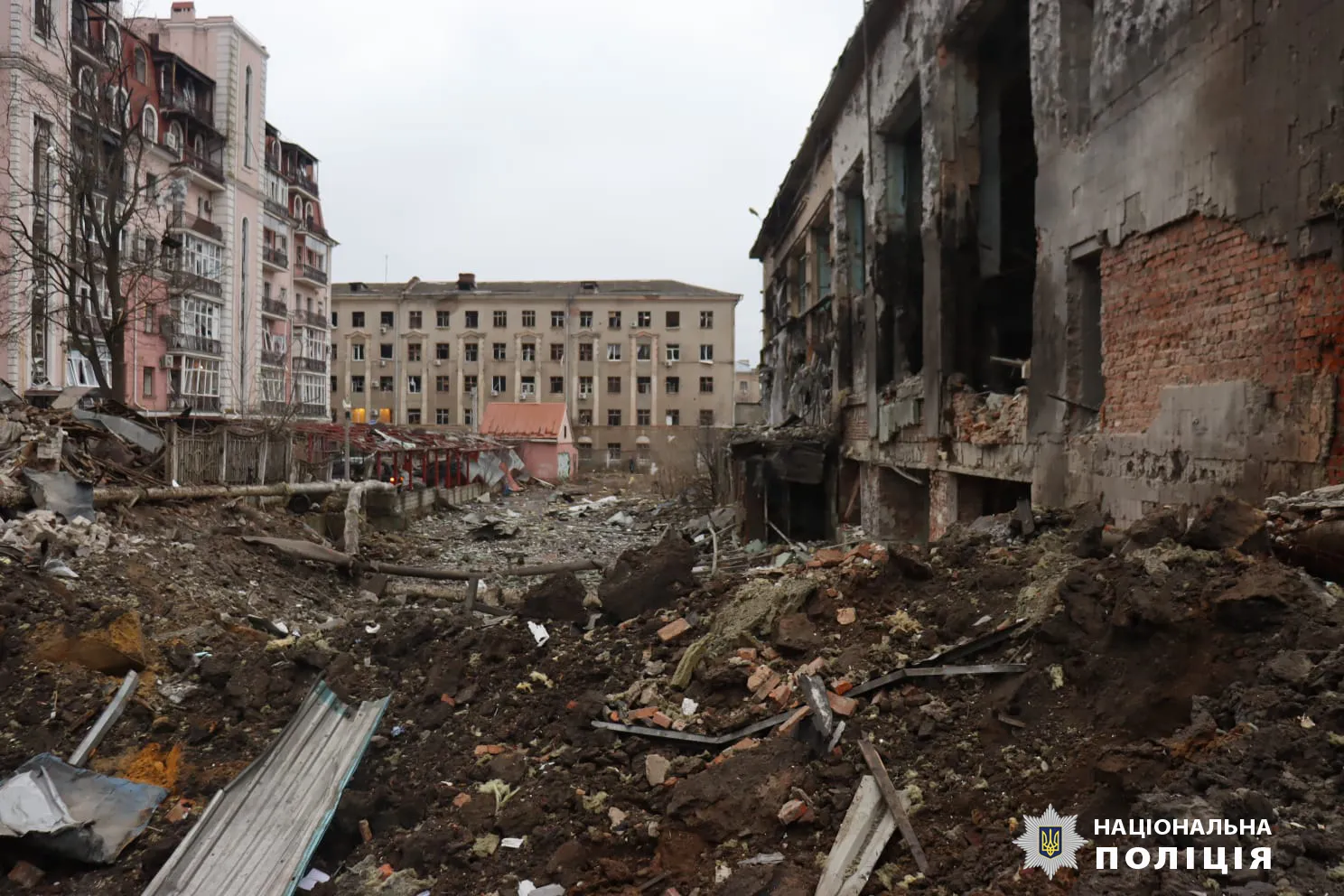
On the morning of 2 January 2024 a ballistic missile landed in Kharkiv, Ukraine's second city, 40 km from the Russian border. When UN sanctions monitors examined the debris, they found it came from a North Korean Hwasong-11, the missile the US and South Korea call the KN-23. Russia, which launched its full-scale invasion of Ukraine in February 2022, had started firing another country's ballistic missiles at Ukrainian cities.
My argument is that the KN-23 matters less as a weapon than as a feedback loop. North Korea had tested this missile into the sea a handful of times. In Ukraine it has been fired at real cities, through real air defense and real jamming, roughly a hundred times by Ukraine's intelligence counts, and within a year its miss distance fell from kilometres to tens of metres. Every strike on Kharkiv or Kyiv is a data point Pyongyang could never have bought, and in 2026 North Korea moved its own missile crews into Russia to collect them firsthand.
What is the KN-23?
A road-mobile, single-stage, solid-propellant short-range ballistic missile. North Korea first tested it in May 2019 near Wonsan. It is 7.5 m long and 0.95 m wide, weighs about 3.4 tonnes and carries an estimated 500 kg warhead. CSIS's Missile Threat project gives its range as 450 km with that warhead and up to 690 km with a lighter one.
It looks like Russia's Iskander-M, and analysts have argued for years over whether that resemblance came from Russian help. What matters for the defender is the flight path. The KN-23 flies quasi-ballistic: lower than a classic ballistic missile, steering with its fins on the way down. A lower path means the radars see it later, and a manoeuvre at the end means the interceptor has to correct harder.
The KN-24 (Hwasong-11B) is a different North Korean design in the same family, closer in shape to the American ATACMS. Ukraine's intelligence reports both as delivered to Russia, usually as one number.
The KN-23 in numbers
| Figure | Value |
|---|---|
| Designation | KN-23 (US and South Korean name), Hwasong-11 (North Korean name) |
| Length, diameter, mass | 7.5 m, 0.95 m, about 3,415 kg |
| Warhead | about 500 kg |
| Range | 450 km with a 500 kg warhead, up to 690 km with a lighter one |
| Flight path | quasi-ballistic, manoeuvring with fins |
| First used against Ukraine | 30 December 2023 (US government) |
| Early miss distance | 500 to 1,500 m (Ukraine's intelligence chief), 1 to 3 km (Ukrainian military source) |
| Miss distance by early 2025 | 50 to 100 m (Ukrainian military source) |
| Delivered to Russia | about 150 KN-23 and KN-24, end of 2023 to August 2025 |
| Left in July 2026 | about 50 of the KN-23 series |
| Estimated cost | about $3 million (Forbes Ukraine estimate, as reported) |
How did a North Korean missile get better in Ukraine?
The first batch was poor. Ukraine's then intelligence chief, Kyrylo Budanov, said in February 2025 that early KN-23s missed by 500 to 1,500 metres, and other Ukrainian accounts describe missiles that veered off course or broke up in the air. A missile that misses a factory by a kilometre lands in a residential district instead, and that is where many of the early ones landed.
Then the numbers changed. In February 2025 a Ukrainian military source told Reuters that the error of more than 20 recent missiles had fallen to 50 to 100 metres. Budanov said Russian specialists had modified the missile and that it was now a far greater threat.
The mechanism is the part an American reader should notice. A missile programme improves by firing, recovering data and changing the design. North Korea had a test range into the sea, with no air defense, no electronic warfare and no way to see where a warhead lands on a city. Russia gave it something no sanctions regime could block: about a hundred launches' worth of results against a defended country, with a partner who could tell it what went wrong. The improvement came from that loop, with Russian specialists making the changes, and it carries into every KN-23 North Korea will build or sell afterwards. Development, combat validation and export marketing now happen in one deployment, and Russia pays for it.
Whose parts are inside it?
Conflict Armament Research, an investigative group that traces weapons components, examined the Kharkiv missile in January and February 2024. It documented more than 290 non-North Korean electronic components from 26 companies in eight jurisdictions, mostly in the navigation system. Three quarters of them were linked to companies incorporated in the United States, 16% to European companies and 9% to Asian ones. Of the parts with readable date codes, more than three quarters were made in 2021 to 2023, so the missile could not have been assembled before March 2023.
So most of the dated parts were not old stock. They reached North Korea within the last few years, despite the UN sanctions that ban its missile production. The same pattern runs through Russia's own missiles: the Kometa anti-jam navigation module and the Iskander's new seekers depend on smuggled electronics too.
How many has Russia received, and how many are left?
Ukraine's intelligence told Reuters in 2025 that 148 KN-23 and KN-24 had been delivered by the start of that year. In August 2026 Andrii Cherniak, a representative of Ukraine's military intelligence, put the total at about 150 between the end of 2023 and August 2025. By July 2026, the same service said, Russia had about 50 KN-23-series missiles left.
Then the supply changed shape. In August 2026 Ukraine's intelligence reported a North Korean missile unit of about 90 people being based in Russia's Voronezh region, north-east of Ukraine's Kharkiv region, with six launchers and up to 120 KN-23 and KN-24 missiles expected, and a new batch of 40 already delivered. At least two were fired at Ukraine in a deadly strike at the end of July 2026. On the night of 7 November 2026, when Russia hit Kyiv's Northern Bridge, the Ukrainian Air Force listed KN-23 among the ballistic missiles in the salvo.
Ukrainian military sources describe the KN-23 as carrying more payload and flying farther than the Iskander but still less accurately, and they connect that to higher civilian casualties where it lands. A heavy warhead that misses by a hundred metres in a city kills people who were nowhere near the target.
Can Patriot stop it?
Yes, and only two systems in Ukraine are built for it. A ballistic missile coming down at several times the speed of sound has to be hit directly, which in Ukraine means Patriot's PAC-3 interceptors and, where it is deployed, the Franco-Italian SAMP/T. I explain the PAC-3 and its limits in the Patriot air-defense system.
The record is uneven. RUSI analysts counted 67 of 179 Iskander-M and KN-23 missiles intercepted in the summer of 2025, and only 14 of 78 between 1 and 24 October 2025. A Ukrainian Patriot commander has said the firing rules allow two to four interceptors per ballistic target, at about $3.9 million each, against a missile estimated at $3 million. In a mixed salvo the KN-23 is one more ballistic track a crew cannot afford to let through, and that is how it spends the defender's stock. I price a whole salvo of that kind in what it costs to stop Russia's bridge-strike salvos.
Where does the KN-23 go next?
Four signals will show which way it goes.
- North Korean crews firing from Russia. If the Voronezh unit is confirmed in combat, the missile, the launchers and the operators all come from Pyongyang. That is a second missile force in the war, outside Russia's own production limits.
- Deliveries beyond the 120. A new contract after the talks Ukraine's intelligence expected in September 2026 would show North Korea treating the war as a standing export market.
- Accuracy against point targets. Strikes on bridges, substations or single buildings with KN-23s would show it has closed the remaining gap with the upgraded Iskander.
- Export customers. A missile improved against a defended country is a different product for the next buyer. The first reported KN-23 sale outside Russia would mean Ukraine's experience has been turned into North Korea's sales pitch.
What will the market need next?
The KN-23 opens gaps that are only partly about interceptors.
- Component tracing as a data product. Investigators trace parts from debris to manufacturers to distributors. Sanctions enforcement agencies, export-control authorities and the compliance teams of large distributors need that work at scale and faster, sold as a subscription data service and priced per seat or per investigation.
- Channel controls for electronics sellers. If three quarters of the parts in the Kharkiv missile came from US-incorporated companies, distributors and brokers carry the risk. Software that screens resellers, flags unusual orders and documents due diligence sells to them, with regulators' penalties as the reason to buy.
- Fast debris identification. Telling within hours which missile hit, from fragments and markings, matters for attribution, for sanctions and for adjusting the defense. Ukrainian forensic institutes already do it by hand. Tools that speed it up have government buyers in Ukraine and among its allies.
- Low-elevation radar coverage near the border. A quasi-ballistic missile on a low path is seen late. Sensors that add warning time over the northern and eastern regions sell to air-defense commands, paid for through allied aid.
What the KN-23 means for a defense founder
- Your parts may already be in a missile. If you sell or design with commercial electronics, your distribution chain is part of your export-control exposure. Know who your distributors sell to.
- Feedback from use is worth more than a new design. North Korea got a better missile from a year of combat data, not from a new airframe. A Western team testing in Ukraine gets the same advantage in weeks that a range test gives in years, and buyers know it.
- Count the allies' factories. Russia's missile stock is no longer only what Russian factories make. Any forecast of what a defender will face has to count Pyongyang's output and, for drones, Tehran's.
Sources (13)
- Associated Press, Russia used North Korean ballistic missiles against Ukraine, White House says, 4 January 2024
- Reuters, UN experts say North Korea missile landed in Ukraine's Kharkiv, 29 April 2024
- Conflict Armament Research, North Korean missile relies on recent electronic components, February 2024
- CSIS Missile Threat, KN-23, updated 23 April 2024
- Kyiv Independent, North Korea improving its missiles' accuracy in Ukraine, Budanov says, 18 February 2025
- Reuters, Ukraine sees marked improvement in accuracy of Russia's North Korean missiles, 6 February 2025
- Kyiv Independent, Russia has 50 Kinzhal missiles after pausing production, HUR claims (KN-23 series stock), 20 August 2026
- Defense News (Reuters), How North Korean forces are bolstering Russia's war against Ukraine, 7 August 2026
- The Defense Post, North Korean unit in western Russia could operate 120 ballistic missiles, 7 August 2026
- UNITED24 Media, Russia launches three waves of ballistic missiles at Kyiv, 7 November 2026
- Militarnyi, Patriot crews and ballistic targets (firing rules of two to four interceptors), 11 April 2026
- RUSI, Iskander improved: Russian missile tests Ukraine's air defence, 18 November 2025
- Espreso, What the KN-23 is (cost estimate attributed to Forbes Ukraine), 22 August 2024