
Dovbush started as an $8,000 scout that volunteers gave to the army, and in 2026 the T40 version is how Ukraine sees 2,000 km deep
Dovbush is a family of Ukrainian fixed-wing drones from a project reported to be led by monobank co-founder Volodymyr Yatsenko. The T20 scouted, spotted artillery and relayed signals for $750 kamikaze drones; the T40, codified by the Ministry of Defense in August 2026, is stated to fly more than 2,000 km and stay up more than 24 hours. Zelensky listed Dovbush for the Kerch Bridge operation without saying what it did. I explain what is public, what it costs, and where the money is.
Ukraine's Ministry of Defense announced on 17 August 2026 that it had codified the Dovbush T40, a fixed-wing unmanned aircraft with a wingspan of almost 5 m, a stated range of more than 2,000 km and an endurance of more than 24 hours. The ministry said that is enough to reach the Urals and western Siberia, and that the aircraft can scout, correct artillery fire, drop munitions or fly into a target. Three months later, on 17 November, President Zelensky listed Dovbush among the eleven Ukrainian systems used in the operation that cut the road span of the Kerch Bridge. I describe that operation in how Ukraine cut the Kerch Bridge road span.
Dovbush is named after a Carpathian folk hero, Oleksa Dovbush, an eighteenth-century outlaw. The project behind it began in 2022 as a volunteer effort, after Russia launched its full-scale invasion of Ukraine that February. ITC.ua, a Ukrainian technology outlet, reported in August 2026 that it was led by Volodymyr Yatsenko, co-founder of the online bank monobank. The ministry itself does not name the maker; it says only that an enterprise with extensive experience in unmanned aircraft built it.
My argument is that the interesting weapon here is the cheap one that sees. Ukraine's strike mix is full of drones that carry a warhead. Dovbush's history is that of a platform that finds targets and passes the picture on, and a 2,000 km version of that is what makes a bridge operation planable.
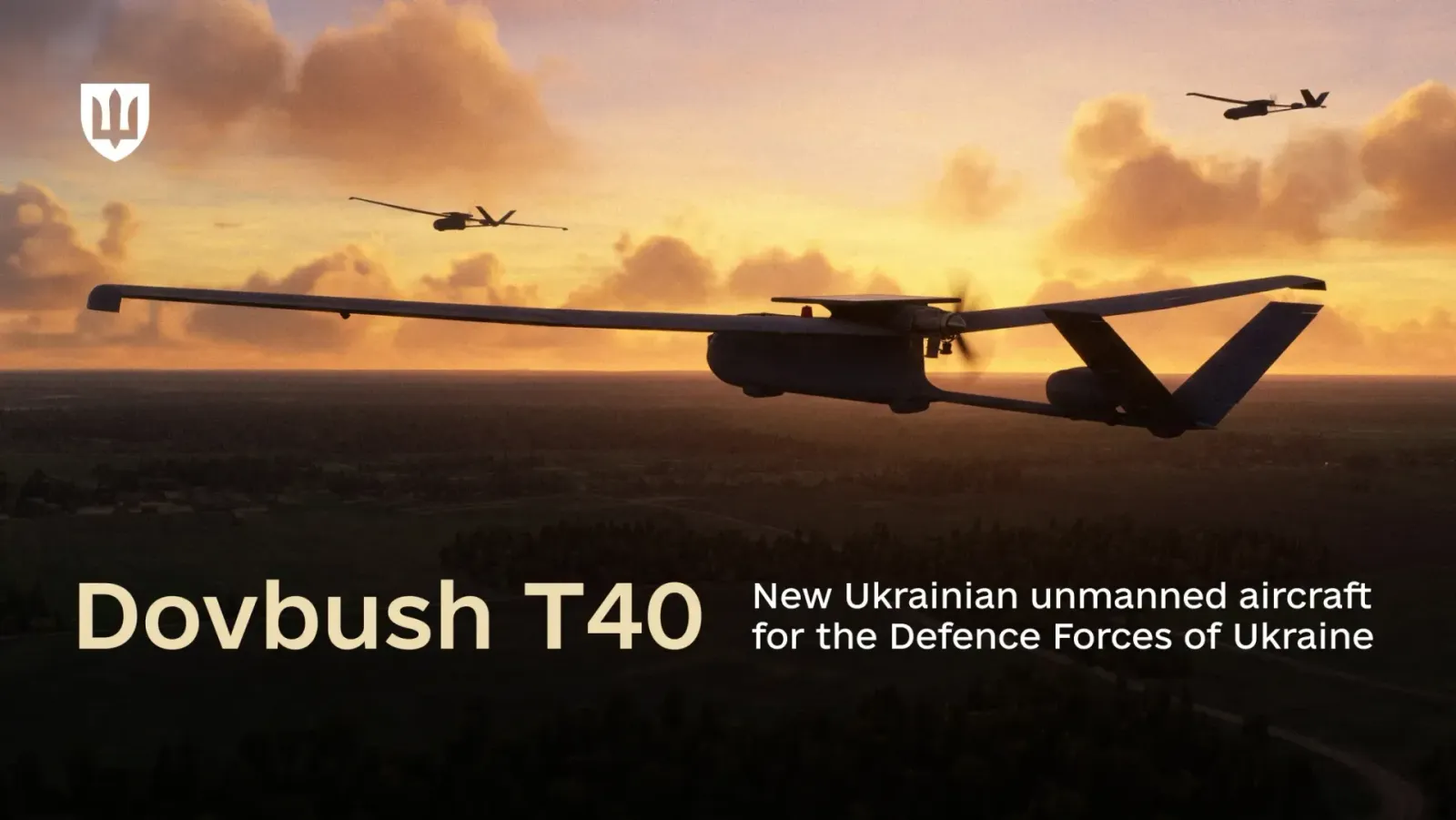
Dovbush in numbers
| T10 | T20 | T40 | |
|---|---|---|---|
| Role | reconnaissance drone that can be modified for strikes | reconnaissance, artillery spotting, signal relay, light strike | strategic: deep reconnaissance, fire correction, strike |
| Introduced | 2022, testing reported December 2022 | in combat since 2022 | codified by the Ministry of Defense, 17 August 2026 |
| Wingspan | not stated | 4.5 m | almost 5 m |
| Munitions | not stated | suspension for up to 5 kg | dropped munitions or kamikaze; payload not published |
| Range and endurance | not stated | not stated; the developer said Moscow was within reach (2023) | more than 2,000 km, more than 24 hours |
| Cost | not stated | about $8,000 per unit (Focus, August 2023) | not published |
| Signature | hard for jamming and air defense to find (Yatsenko, 2022) | own radio link and ground station | "ultra-low radar signature" and high resistance to jamming (Ministry of Defense) |
| Engine | not stated | not stated | high-performance engine with electronic fuel injection |
The T20 went into combat with a companion. Kotyhoroshko, named for a Ukrainian fairy-tale hero, is a kamikaze drone priced at about $750, and the T20 flies above it as a radio relay, because a small drone's signal dies at a few kilometers when the Earth's curve gets in the way. In August 2023 the project aimed for about 1,000 aircraft a month, was building hundreds and had a military request for 4,000 a month. The drones were given to the army free of charge, and early units were made in another European country. Those figures are three years old and I treat them as history.
How does the T40 reach 2,000 km?
My reading is that it is a light aircraft carrying a lot of fuel and a small payload. The ministry publishes neither figure, and nothing in its notice cuts against that. A 5 m wingspan is smaller than the 6.7 m of Antonov's Liutyi, whose reported warhead is 50 to 75 kg. The ministry published no payload for the T40, and I do not infer one. What the airframe size and the T20 record suggest is a strike load that is light, and a primary job as a sensor and a relay that happens to carry a few munitions.
That is a different product from a long-range warhead carrier. A one-way drone such as the FP-1 is bought to be consumed. An aircraft that can stay up for a day is bought to look, to come back, to correct the fire of weapons that cost more than it does and, when needed, to attack.
Why call a platform "codified"?
Codification is the Ministry of Defense's approval of a system for use by the defense forces, after tests. The ministry says the T40 met the characteristics its developers stated, and that it has codified 413 unmanned systems since the start of 2026, nearly all Ukrainian-made. For a supplier the point is practical: a codified system can be bought by the army with the state's money, and an uncodified one depends on volunteers and donors. I cover the wider route in how Western money reaches Ukrainian producers.
What did Dovbush do at the bridge?
No official source says. Zelensky listed it. Ukrainian news site ZN.ua described the Dovbush system as one that can scout, carry first-person-view drones or relay communications, in its own words rather than the SSU's. Defense Express, the Ukrainian defense outlet, read the record as Dovbush being used throughout the month, against air defenses first and against the bridge itself. It added that the strategic T40 is the likeliest variant and that nobody has confirmed which flew.
My reading is that the Dovbush is the part of the operation that is about knowing where to hit. A month-long campaign that began by destroying air defenses, radars and electronic warfare equipment on the way to the bridge needs fresh pictures of those sites, and needs an aircraft that survives long enough to take them. The span itself fell, per the SSU, to Palianytsia missile-drones, described in Palianytsia.
Dovbush had also been named in an earlier strike. Among the nine aerial drones that Ukraine used with the missiles in the 11 to 12 August 2026 strike on the Novorossiysk naval base were Dovbush and Liutyi, according to Kyiv Post.
What will the market need next?
The platform sells a sensor and a link, and the buyers are the units that fire the expensive weapons.
- Relay and data links that survive jamming. The T20's reason to exist was a radio relay for a $750 drone. A deep-reconnaissance aircraft that sends its picture home from 2,000 km needs a link that survives that distance and jamming, and the link is a business: radios, antennas, satellite terminals. The buyer is the maker and then the army.
- Small munitions for a light airframe. Dropped munitions of a few kilograms, with a seeker and a fuze, priced so that the aircraft that carries them is not the larger cost.
- Targeting software that consumes the video. An aircraft that flies a day produces hours of footage. Software that finds the radar or the pontoon in it and hands coordinates to a missile battery saves an analyst's shift. Ukrainian command software of this kind is described in the battlefield software map.
- Engines that run for a day. An engine with electronic fuel injection is the only propulsion detail the ministry gave. Durability for 24 hours is a supplier's sale, in the class I describe in small aircraft engine selection.
- Low-signature materials and finishes. The ministry claims an ultra-low radar signature without saying how. Composite airframes and coatings that cut radar return have a buyer in every long-range drone maker.
What Dovbush means for a defense founder
- The cheap sensor is the product. The T20 cost about $8,000 and was given away. The T40 was codified. The path from volunteer gift to ministry approval took nearly four years, and it is the one a founder without a state contract can follow.
- A single name can hide three products. T10, T20 and T40 differ in size, range and job. A buyer who reads "Dovbush" in a list needs the variant. A maker that publishes the table above is easier to buy from.
- Say who makes it. The ministry's notice names no company, and the reporting that names the lead names it from outside. A supplier or investor looking for the maker finds a gap, and a gap in a due-diligence file is a reason to ask for another vendor.
Sources (11)
- Ministry of Defense of Ukraine, Capable of reaching Siberia: Ministry of Defence codifies Dovbush T40 drone, 17 August 2026
- ITC.ua, the Ministry of Defense codified a combat drone that flies more than a day, 19 August 2026
- UNITED24 Media, Meet Dovbush T40, August 2026
- Euromaidan Press, This new drone stays aloft for more than a day, 17 August 2026
- UNIAN, Dovbush drone: what the Ukrainian drone is and its characteristics, 26 December 2022
- Focus, Dovbush T20 and Kotyhoroshko: Volodymyr Yatsenko on Ukraine's new combat drones, 1 August 2023
- Defense Express (Defence-UA), What did Ukraine use to clear the way to the Crimean Bridge and strike it, 17 November 2026
- ZN.ua, the SSU gave details of the operation and named the weapons, 17 November 2026
- Kyiv Post, From Flamingo to Neptune: Zelensky reveals details of the Crimea Bridge strike, 17 November 2026
- Kyiv Post, Ukraine's 15-weapon Novorossiysk strike, 13 August 2026
- UNITED24 Media, Zelenskyy reveals what missiles and drones struck the Crimean Bridge, 17 November 2026