
The S8000 Banderol, number by number, and what each one means for the defender
A specification sheet only matters for what it lets the missile do to the side that has to stop it. Here is every Banderol figure, read that way.
S8000 Banderol specifications read like any datasheet, but each number is a decision someone made about cost, and each one lands on the defender as a separate problem. Speed decides which layer of air defense can engage it. The turn radius decides where it can fly. The price and the monthly output decide who runs out first. Here is every figure that matters, and what I read in it. Where the missile has been used, and why it matters to the industry, is in the overview.
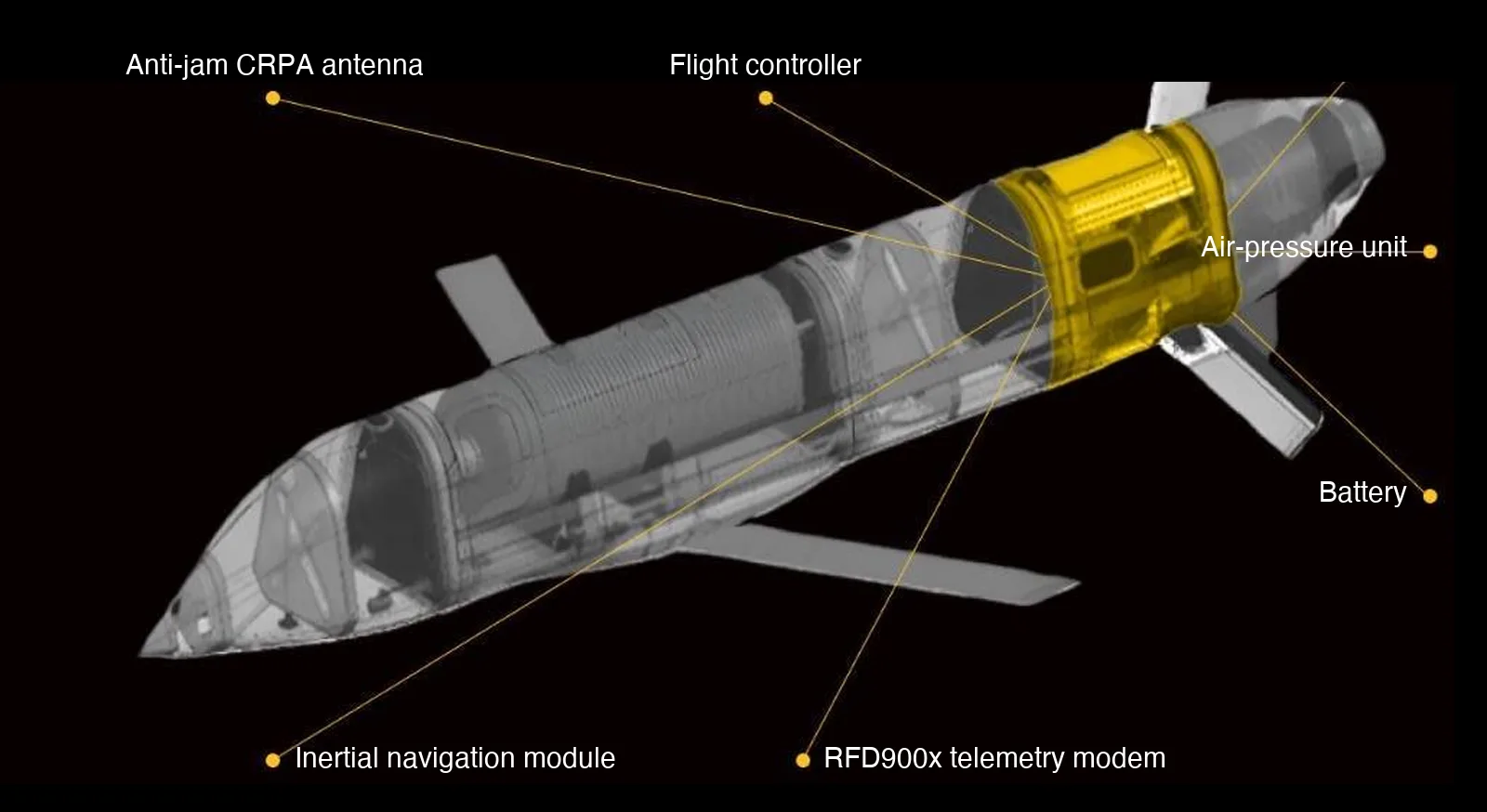
The numbers, side by side
| Figure | Value | What it means |
|---|---|---|
| Length, diameter | about 5 m, 30 cm | Small and composite: a weak radar reflector, though not stealthy |
| Wingspan | just over 2 m, folding | Fits under a drone and into a ground launcher |
| Launch mass | 200 to 250 kg | Light enough for the Orion drone to carry |
| Engine | Swiwin SW800Pro-A95 turbojet, China: 8.5 kg, 19 cm across, 35 cm long, about 82 kgf at 65,000 rpm, about $16,000 | A hobby-market part as the core of a strike weapon |
| Fuel | 50 to 65 kg of aviation kerosene | Sets the range, and spends itself faster on a ground launch |
| Cruise and top speed | 520 to 560 km/h, 620 to 650 km/h | About three times the 180 km/h of a Shahed, the Iranian-designed attack drone |
| Declared range | 500 km | The maker’s figure |
| Practical range | 350 to 400 km, less 100 to 200 km from a ground launch | Ukraine’s intelligence, after studying series missiles; the Air Force on ground launch |
| Navigation | Kometa-M8 anti-jam satellite antenna, plus an inertial unit built on an InvenSense ICM-42688-P six-axis MEMS sensor | Keeps working when satellite signals are jammed |
| Accuracy | 20 to 30 m circular error | Enough for terminals, depots and ports |
| Minimum turn radius | about 2.5 km; a 90° turn recorded above 250 km/h | Exceptional for a cruise missile |
| Warhead | 114 kg high-explosive fragmentation, 49.5 kg of it aluminized explosive | Built for area and fire, not crater depth |
| Foreign components | 20 to 30, from seven countries | None of them military, none under direct sanctions |
| Unit cost | estimated $50,000 to $300,000 | Several times below a Kh-101, Russia’s main long-range cruise missile, even at the top |
| Output | about 80 a month, two or three a day across three shifts | Ammunition, not a precious weapon |
| Interception | over 80%, by Ukraine’s account | Shot down often; the question is at what cost |
What is inside: the bill of materials
Ukraine’s intelligence published every foreign part it found, with manufacturers and, for many chips, the production date. The ones that carry the design:
| Function | Part | Manufacturer | Country |
|---|---|---|---|
| Engine | SW800Pro-A95 turbojet | Swiwin | China |
| Anti-jam satellite antenna | Kometa-M8 | VNIIR-Progress | Russia |
| Motion sensor, inertial unit | ICM-42688-P six-axis MEMS | InvenSense (TDK) | US |
| Microcontrollers | STM32F427 and STM32F103 | STMicroelectronics | Switzerland |
| Control surfaces | MX-64AR servos | Dynamixel (Robotis) | South Korea |
| Telemetry | RFD900x radio modem | RF Design | Australia |
| Wireless | EFR32 system-on-chip | Silicon Labs | US |
| Power | US18650VTC battery cells | Murata | Japan |
| Power regulation | LM2576, LM2596, XL4015 converters | Texas Instruments, HTC Korea, XLSEMI | US, South Korea, China |
| Signal and timing | NE555 timer, LM358 amplifier, MAX2235 RF amplifier, ADM202 and SP3485 interface chips, FM25V02 memory, Toshiba couplers | Texas Instruments, Maxim (Analog Devices), Analog Devices, MaxLinear, Cypress (Infineon), Toshiba | US, Japan |
Read as a procurement document, it says three things. Every part except the antenna is sold to civilian buyers in volume. The chips are recent: date codes run from 2021 to the first weeks of 2024, so they were bought after the 2022 export controls, not pulled from old stock. And the electronics converge on a few Russian importers: JSC Chip and Dip for most of the chips, IQ Components and Trek for the engine, TK Mir for the servos. A supply chain that wide is hard to close. A supply chain that narrow at the Russian end is where pressure works.
What do the speed and the turn radius mean for air defense?
Speed puts it out of reach of the cheap layer. A mobile fire team with a heavy machine gun works well against targets up to about 250 km/h. A dedicated interceptor drone tops out around 370 km/h. The Banderol flies at 520 to 560 and can go past 600. It cannot be chased, and a gun crew has seconds to detect, aim and fire.
The turn radius is the number that surprised me most. A Kh-101 or a Kalibr, Russia’s large air- and sea-launched cruise missiles, needs kilometres of arc to change direction. The Banderol turns in about 2.5 km, and Ukraine’s intelligence recorded one turning through 90° above 250 km/h. That lets it follow a river bed or a tree line, go around a defended zone that was scouted in advance, and arrive from the side nobody was watching. There is no breakthrough behind it: low weight, a strong airframe and precise servos, the same South Korean servos that were built for robotics labs.
What does the range really allow?
Treat 500 km as the brochure. A missile released from a drone gets speed and altitude for free; one fired from the ground spends its own fuel climbing and accelerating, and the Air Force puts that loss at another 100 to 200 km. The figure I would plan on is Ukraine’s intelligence estimate for series missiles: 350 to 400 km. That is still deep enough to reach any logistics hub in eastern and southern Ukraine.
What do the warhead and the accuracy buy?
A 20 to 30 m circular error would be poor for a bridge support and is more than enough for a postal terminal, a grain warehouse or a port. Navigation runs on two independent loops. The satellite loop uses the Kometa-M8, a multi-element antenna array that steers nulls toward jamming sources, so the receiver keeps the satellite signal as if the jammer were not there. The inertial loop runs on an American six-axis MEMS sensor, a three-axis gyroscope and a three-axis accelerometer in one chip; if satellite signals are lost entirely, the autopilot flies on the inertial unit and the altimeter until the signal comes back or the flight ends. Jamming the satellite signal alone does not stop it reaching the target area. The warhead fits that job: 49.5 kg of aluminized explosive, where the burning metal extends the blast and adds heat. The damage it is built for is area and fire. A basic Shahed carries about the same amount of explosive, three times slower.
What do the cost and the output mean?
Here the numbers stop being engineering. At $50,000 to $300,000, even the top estimate is several times below a Kh-101, and the missile is often met by a Western air-defense missile that costs many times more than either. At 80 a month, two or three a day, it is ammunition. I go through what that ratio does to a defender in cost-exchange ratio, and through what changes as output grows in the risks at 80, 150 and 400 a month.
Which numbers I would build a plan on
If I were sizing an interceptor or a sensor network against this threat, four numbers would carry the plan. Speed above 500 km/h, because it decides which tools are useless. The 2.5 km turn, because it decides how much ground a sensor network has to cover. The cost range, using the low end, because a defense that only breaks even against a $300,000 missile loses against a $50,000 one. And the output, because the defender has to match a rate, not a missile.
The companies that win this market will not be the ones with the longest specification sheet. They will be the ones whose assumptions survive contact with numbers like these. I go through how I check a defense company’s own claims in how I would evaluate a defense tech startup. What the missile is and where it has been used is in the overview, and how it is employed in why a cheap cruise missile is hard to stop.
What will the market need next?
The numbers set a price ceiling for the defense. A missile that costs $50,000 to $300,000 and that Russia fires at Ukraine two or three times a day can only be met night after night by something that costs less than it does, and that is the band where the market has almost nothing in volume: an interceptor under about $50,000 that catches a target at 520 to 560 km/h close to the ground.
There is a less obvious gap as well. Anyone building that interceptor needs targets to test it against, and realistic targets for a low-flying jet missile are expensive and scarce. Cheap jet-powered target drones that fly the Banderol's profile, sold to test ranges, armies and interceptor makers, are a business in their own right.
Signals worth watching: interceptor programs that publish a unit price below $50,000, orders for jet-powered target drones, and Russian output figures from Ukrainian intelligence.
The Banderol series
- What the Banderol is, read from Ukraine’s teardown
- The specifications, number by number (this article)
- How it is used, and why it gets through
- The risks at 80, 150 and 400 a month, and the counters
- Cost-exchange ratio, the number air defense has to design to
- Why the US needs cheap interceptors more than its own Banderol