
The An-196 Liutyi was built to be spent on one target, and Antonov has now shown it as a reusable carrier for four missiles
The An-196 Liutyi is the long-range strike drone of Antonov, Ukraine's state aircraft maker. It costs about $200,000, carries up to 75 kg over 1,000 to 2,000 km and has hit Russian refineries and ports. In July 2026 Antonov showed it carrying four small missiles as a reusable carrier. I go through what it carries and costs, why it is changing, and what the change opens for suppliers.
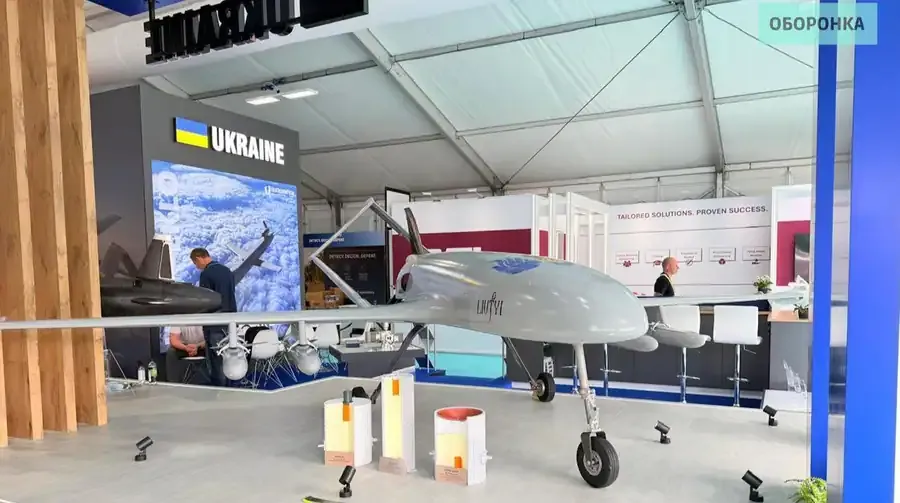
On 21 July 2026, at the Farnborough International Airshow in England, the Ukrainian stand showed a grey long-winged drone with the word "Лютий" on its nose and four orange missiles under its wings. It was the An-196 Liutyi, Antonov's long-range strike drone, which until then had been a weapon that dies with its target. At Farnborough it was presented as a reusable carrier with four missiles under its wings; the public record does not yet show a reusable combat mission.
The Liutyi has been one of the workhorses of Ukraine's long-range strikes on Russian territory since Russia's full-scale invasion of Ukraine in February 2022. Antonov, the Kyiv aircraft maker known for the world's largest cargo planes and now part of Ukroboronprom, Ukraine's state defense group, builds it. On 17 November 2026, President Zelensky's list of eleven weapons used in the operation against the Crimean Bridge included the An-197, which is most likely built on the Liutyi.
My argument is that the Liutyi's change of role is a price story. A one-way airframe at about $200,000 faces cheaper Ukrainian competitors, and Defense Express reads the reusable version as Antonov's answer. Reuse changes the unit of cost from the airframe per target to the airframe's whole service life plus the missiles per mission. Whether it pays depends on two things nobody has published yet: how many missions a Liutyi survives, and what the missiles under its wings cost.
An-196 Liutyi in numbers
| Maker | Antonov, a state enterprise in the Ukroboronprom group; CNN named it the developer in October 2024 |
|---|---|
| What it is | One-way attack drone, propeller-driven, piston engine; first announced in October 2022 |
| Size and weight | 4.4 m long, 6.7 m wingspan, 250 to 300 kg |
| Warhead | 50 to 75 kg |
| Range | 1,000 to 2,000 km stated; a longer-range An-196 RS is stated at 2,500 km |
| Price | About $200,000 each (Militarnyi, December 2024) |
| Production | "In the hundreds"; Germany reportedly financing 500 more for about $100 million (Euromaidan Press, July 2026) |
| New version | Reusable carrier shown with four missile mock-ups at Farnborough on 21 July 2026; missiles reported at about 200 km and above 500 km/h |
| In the field | Strikes on Russian refineries and plants; the Novorossiysk port strike of 11 to 12 August 2026 |
What does a Liutyi cost per kilogram of explosive?
At about $200,000 and 75 kg, roughly $2,700 per kilogram of warhead. That is below the $3,300 to $4,400 I calculate for Anduril's Barracuda-500M and far below a Tomahawk. It is above Fire Point's FP-1, which carries a similar load for roughly a quarter to a third of the price, and above the heavy FP-5 Flamingo missile, at about $520 per kilogram.
The Liutyi's advantages are elsewhere. It runs on a small piston engine, so it does not compete for the scarce small jet engines that jet missile-drones such as Palianytsia need. It has a long record against refineries and plants deep inside Russia. And it comes from a state maker with an aircraft design bureau behind it. Its weakness is the price: as a one-way weapon it leaves room for cheaper systems to compete on cost, which makes reuse interesting even before it is proven.
Why turn it into a missile carrier?
Because an airframe used once loses to a cheaper one, and an airframe used many times may not. Defense Express, as reported by UNIAN in July 2026, read the Farnborough version as Antonov's answer to the FP-1. The reusable Liutyi carries four small missiles under its wings. Army Recognition reports their range at about 200 km and their speed above 500 km/h; UNITED24 notes the warhead has not been disclosed. Militarnyi wrote that the missiles may fly to coordinates programmed before launch, without a seeker of their own.
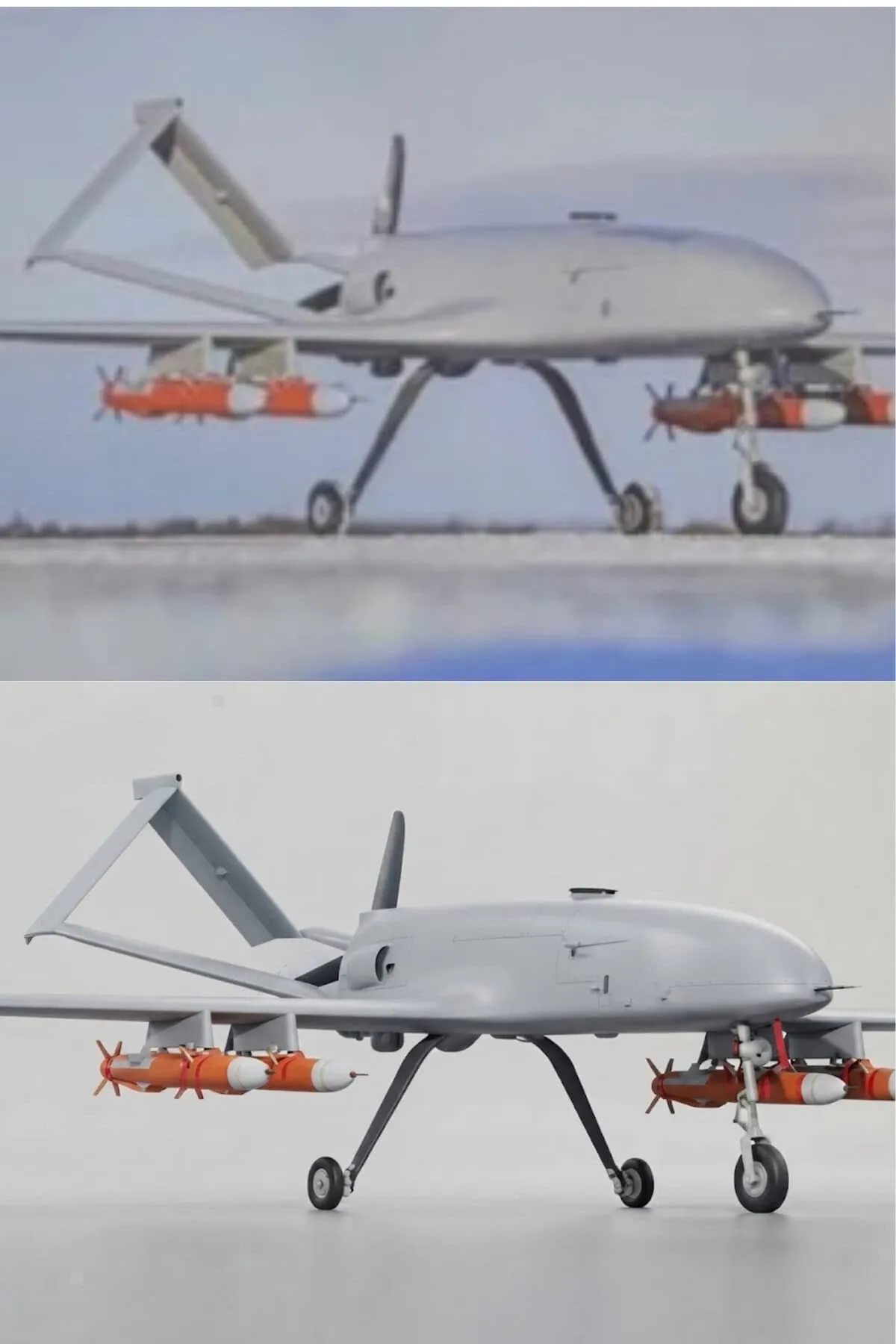
The change moves the Liutyi from the economics of a shell to the economics of an aircraft. A one-way drone has to be cheap enough to lose every time. A carrier has to come back often enough that its price, spread over its missions, beats the one-way alternative, and its missiles have to be cheap enough to fire four at a time. A missile with about 200 km of reach would let the carrier release its weapons before it reaches the target. Whether that keeps the Liutyi outside the defenses depends on the defenses, the route and the launch point.
My view is that the idea is right and the proof is missing. Reuse raises questions the one-way version never had to answer in public: recovery, turnaround time, engine life, rearming and navigation on the way home. None of those figures has been published.
Where has the Liutyi been used?
Its record is against fixed industrial targets deep inside Russia: refineries, plants and ports. Kyiv Post listed it among the nine types of aerial drones in Ukraine's strike on the Russian naval port of Novorossiysk on 11 to 12 August 2026. A Liutyi wreck was also found in Finland in March 2026.
In the Crimean Bridge operation, Zelensky's list named the An-197, not the An-196. No source gives the An-197 a stage or a target.
What will the market need next?
If the Liutyi line becomes a returnable carrier, the money moves to what sits around the airframe:
- Small guided missiles in the 100 to 200 km class, cheap enough to carry four on a $200,000 drone. The seeker and the warhead are the product.
- Engines with a longer life. A one-way engine runs for hours; a reusable one needs tens of hours between overhauls.
- Recovery and turnaround. Ground equipment, rearming and maintenance records for a 6.7 m wingspan aircraft.
- Navigation for the trip home. A one-way drone can accept a lost signal at the end. A carrier cannot.
What the Liutyi means for a defense founder
The number to watch for a reusable Liutyi is no longer the price of an airframe. It is the cost per delivered weapon across the aircraft's service life. Until Antonov publishes or demonstrates the recovery rate, turnaround, airframe life and missile cost, the reusable version is a plausible design whose advantage cannot yet be calculated. If you supply engines, missiles or navigation, that gap is where the next contracts in this line will be written, because the parts a reusable carrier needs are not the parts the one-way drone was built with.
Sources (8)
- Militarnyi: An-196 Liutyi armed with compact air-to-surface missiles, 21 July 2026
- Euromaidan Press: Ukraine's most feared kamikaze drone shows up at a UK arms fair carrying missiles, 21 July 2026
- UNIAN: why the Liutyi drone became a reusable missile carrier, citing Defense Express, 21 July 2026
- Army Recognition: Ukraine's An-196 Liutyi returns with a new role carrying four missiles, July 2026
- UNITED24 Media: Ukraine turns its suicide drone into a cruise missile carrier, July 2026
- Kyiv Post: Ukraine's 15-weapon Novorossiysk strike, 13 August 2026
- Ukrainian Wikipedia: Liutyi (UAV), specifications, cost and strikes
- English Wikipedia: Liutyi, variants and strikes
Where this comes up on the site
- The An-197 was named in the Crimean Bridge strike and described nowhere. What is known, and what it is most likely built on
- Dovbush started as an $8,000 scout that volunteers gave to the army, and in 2026 the T40 version is how Ukraine sees 2,000 km deep
- Ukraine spent a month taking apart the Crimean Bridge's defenses, then hit one arch two nights running. How eleven Ukrainian weapons dropped the span