
Ukraine spent a month taking apart the Crimean Bridge's defenses, then hit one arch two nights running. How eleven Ukrainian weapons dropped the span
On the night of 17 November 2026 the road span of the Crimean Bridge fell into the Kerch Strait. It was the seventh stage of an operation that ran for about a month and used eleven Ukrainian drones and missiles. I go through how the strike was built: the weeks spent on air defense, the two nights on one arch, the mix of weapons at the end and the operator who steered the last missile. Then why this attack dropped a span when three earlier ones did not, why the wreck now blocks Russia's own shipping, and what the method tells anyone building long-range strike.
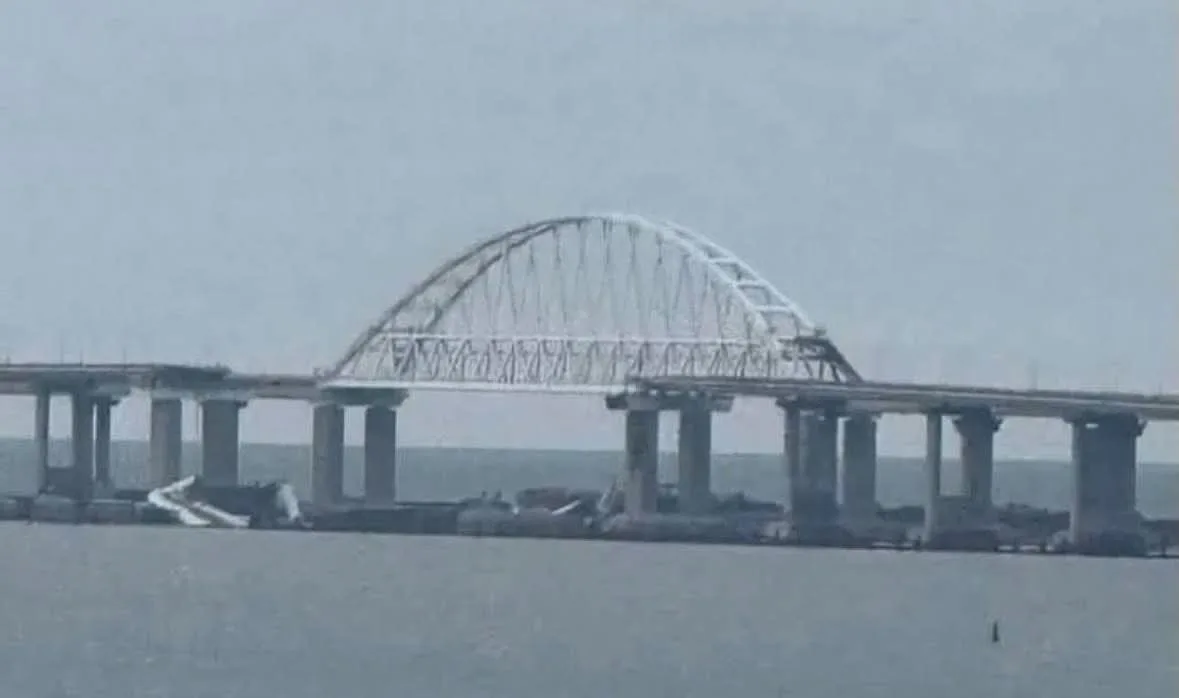
At 1:34 a.m. on 17 November 2026, Sergey Aksyonov, the official Russia installed to run occupied Crimea, posted that "the enemy attacked the Crimean Bridge again." By morning the footage showed what he did not say. One of the bridge's two steel arches, the one that carries the road over the shipping channel, was lying in the Kerch Strait, together with the road span it held. The rail arch beside it was still standing. Russia's Transport Ministry stopped all road and rail traffic. By midday Ukraine's President Volodymyr Zelensky, the General Staff and the Security Service of Ukraine (SSU) had claimed the operation and listed the weapons: Dovbush, Vendetta, Da Vinci, Sichen, MICH 2000, Ruta, Palianytsia, An-197, FP-1, FP-5 Flamingo and R-360 Neptune. Ukraine's Ministry of Defense counts all eleven as Ukrainian systems. Two of them, the Ruta missile and the Da Vinci drone, carry the name of Destinus, a company with Dutch venture money behind it; the weapons are Ukrainian.
The bridge is 19 kilometers long and links Russia's Krasnodar region with Crimea, the Ukrainian peninsula Russia seized in 2014. Russia built it for about 228 billion rubles, roughly $3.7 billion, opened the road in 2018 and the railway in 2019, and has relied on it since its full-scale invasion of Ukraine in February 2022. Ukraine's General Staff calls it the main route for Russia's fuel, ammunition, equipment and troops into Crimea and the occupied south. Kyiv has hit it three times before, and each time Russia reopened it within months.
My argument is that the span fell to a method, and the method is the news. Ukraine spent weeks taking apart the defense around the bridge before it struck the bridge itself, hit the same arch two nights running, sent different kinds of weapons at the road and the rail at once, and gave the last missile to an operator who steered it onto the arch. No single one of the eleven weapons could have done this alone. The sequencing resembles the layered salvos Russia fires at bridges inside Ukrainian cities; the target does not. Ukraine hit a military supply route into territory Russia occupies. And the collapse did something the planners of the bridge never priced in: the wreck now sits in the dredged channel that large ships use between the Black Sea and the Sea of Azov, so the bridge Russia built to hold occupied Crimea is blocking Russia's own ports.
The Kerch Bridge strike in numbers
| Final strike | Night of 16 to 17 November 2026, after a drone hit on the same arch on 16 November |
|---|---|
| Operation | About a month, seven stages (SSU); "several weeks" (Zelensky) |
| Run by | SSU and the General Staff; final stage joined by Navy deep-strike units, the Missile Forces and Artillery, the 7th Deep Strike Center of the 414th "Magyar's Birds" Brigade and the 1st Separate Unmanned Systems Center |
| Weapons named | 11, all Ukrainian: Dovbush, Vendetta, Da Vinci, Sichen, MICH 2000, Ruta, Palianytsia, An-197, FP-1, FP-5 Flamingo, R-360 Neptune |
| What fell | The road arch over the shipping channel and the road span under it. The main span is 227 m |
| What stands | The rail section; its arch is damaged. One rail track reopened on 17 November |
| The channel | 120 m wide; the passage large ships use between the Black Sea and the Sea of Azov |
| Bridge cost | About 228 billion rubles, roughly $3.7 billion |
| Earlier attacks | Truck bomb, October 2022; Sea Baby naval drones, July 2023; underwater charges, June 2025 |
| Last repair times | Road fully reopened 4.5 months after the 2022 blast; whole bridge 3 months after the 2023 one |
How did the operation run, stage by stage?
What is public comes from three statements on 17 November: Zelensky's, the General Staff's and the SSU's. They agree on the shape. The SSU says the operation took about a month and had seven stages, some of which it struck alone. In the first six, Ukrainian forces destroyed, in Zelensky's words, "air defense systems, radars, electronic warfare equipment and other designated targets on the way to the final objective." Destinus said its LORD drones, which Ukraine calls Da Vinci, were used against Russian air defense.
The bridge was not undefended. After the attacks of 2022 and 2023, Russia surrounded it with air defense, floating barriers, sunken barges and booms against sea drones, and its officials called it one of the best-protected objects in the country. Those defenses explain the six stages before the seventh. Each air-defense battery, radar and jammer destroyed on the approach is one fewer that can engage the missiles at the end.
Stage seven ran over two nights. Early on 16 November a one-way attack drone hit the road arch on the Kerch side. Video showed the arch deformed; early estimates put the tilt at about 15 degrees, a later one at 4.9. The Kremlin called the damage "minor" and reopened the road one direction at a time, after about 2,000 vehicles had been stranded. The same nights, Ukraine sent its largest drone attacks of the war across Russia, which spread the air-defense crews thin.
The second night finished the arch. Crimea declared missile alerts at 12:56 a.m., 3:52 a.m. and 5:03 a.m. According to the SSU, its Alpha special forces hit the road section with Palianytsia missile-drones, and the arch and the span under it went into the water. Neptune missiles, Ruta and FP-5 Flamingos hit the rail section. The Unmanned Systems Forces, the branch of Ukraine's military that runs drones, struck targets, overloaded the defenses and relayed the signals for the final missile strike, the General Staff said.
How was the strike built?
Read the three statements together and the operation has five working parts. Each one answers a specific way the bridge had survived before.
Take the defense apart before touching the target. Six of seven stages went to air defense, radars and electronic warfare around the approach, over about a month. A battery destroyed in week two cannot be replaced in time for week four, and the strike that arrives at the end meets whatever is left. Russia had spent three years adding layers to the bridge's protection. Ukraine took the layers off one at a time, on its own schedule, instead of trying to punch through all of them in one night.
Keep the rest of Russia busy on the same nights. The bridge strikes came during the largest Ukrainian drone attacks of the war on Russian territory. An air-defense commander who has to cover Moscow, the refineries and Crimea at once cannot send everything to Kerch. The General Staff says the drone units "overloaded" the defenses on the way to the final strike.
Hit the same element twice. On 16 November a drone bent the road arch. Russia called the damage minor and reopened the road. The next night the strike came back to the same arch before anyone could reinforce or repair it. The first hit weakened the structure; the second used the weakness.
Send different weapons at two aim points at once. On the final night jet-powered Palianytsia missile-drones went at the road section while Neptune and Ruta cruise missiles and FP-5 Flamingos went at the rail section. Different speeds, sizes and flight profiles, at two targets, make it hard for a defender to set up for any one of them. TWZ's analysts make the same point about multi-vector attacks that mix several missile and drone types.
Give the last missile to a person. A Flamingo was steered by an operator through its final approach onto the arch. The weeks before were spent so that this one link, and this one decision at the end, could happen.
Behind the five parts is a sixth that is easy to miss: the operation was run by the SSU and the General Staff together, with Navy deep-strike units, the Missile Forces and Artillery and two drone formations of the Unmanned Systems Forces joining at the end. Each brought its own weapons. Getting eleven systems from several commands to arrive in the right order over a month is a capability in itself, and it is the one Russia will find hardest to copy or to counter.
What did each weapon do?
Kyiv assigned roles to six of the eleven. The rest are listed, and their part is public only as "the stages before."
| Weapon | Type | Role on the bridge, as stated |
|---|---|---|
| Palianytsia | Jet-powered missile-drone | Hit the road section; the span fell (SSU) |
| R-360 Neptune | Cruise missile | Hit the rail section |
| Ruta | Low-cost cruise missile (Destinus) | Hit the rail section (Zelensky); "seven Ruta hit the bridge, one span collapsed" (Destinus) |
| FP-5 Flamingo | Heavy cruise missile, Fire Point | Hit the rail section; one was steered to impact by an operator |
| Da Vinci (LORD) | Strike drone (Destinus) | Used against Russian air defense (Destinus) |
| FP-1 | Long-range strike drone, Fire Point | The earlier stages |
| Dovbush, Vendetta, Sichen, MICH 2000 | Long-range strike systems | The earlier stages |
| An-197 | Long-range strike drone (most likely built on the An-196 Liutyi) | The earlier stages |
Two details in that list matter more than the rest.
The first is the Flamingo's last seconds. Zelensky said the missile's communications link "worked flawlessly until the very last seconds," and the video he released is the missile's own camera closing on the arch. That is man-in-the-loop terminal guidance: an operator watches the target come up and corrects the aim point in the final approach, instead of relying only on coordinates loaded before launch. Here the aim point was a steel arch. The link held after weeks of strikes on Russian air defense, radars and jammers, and the General Staff says drones of the Unmanned Systems Forces relayed signals for the final missile strike. The week before, there had been public reports of disruptions to Ukraine's access to Starshield, SpaceX's military satellite service, which SpaceX denied. My reading is that the Flamingo's link ran over Starshield. Crimea is Ukrainian territory, so a strike on the bridge is a strike inside Ukraine, and the use of the service there was legitimate.
The second is the argument over who dropped the span. The SSU says Palianytsia did it. Destinus says seven of its Rutas hit and one span collapsed. Zelensky puts Ruta on the rail section. All three can be partly right, because the arch had already been bent the morning before. My market reading is that battle credit now has commercial value. Destinus, Fire Point, which makes the FP-1 and the Flamingo, and the state makers all have reason to establish which system produced the picture of a falling bridge, because that picture is what the next buyer remembers.
Why did this attack drop a span when three before it did not?
The earlier attacks damaged road spans, the roadway and the underwater supports, and Russia restored service after each. In October 2022 a truck bomb dropped two road spans, and the road was fully open again in about four and a half months, the railway in about seven. In July 2023 Sea Baby naval drones hit the supports; the bridge was fully open in three months. In June 2025 the SSU detonated more than a ton of explosives on the underwater supports.
This strike removed something of a different order. The two shipping-channel arches are the only parts of the bridge that span 227 meters with 35 meters of clearance for ships. They were assembled on shore and lifted into position in August and October 2017. Replacing one is a large fabrication and heavy-lift job, done this time in a strait within reach of Ukrainian drones and missiles, which makes it a different problem from patching a road span. Emil Kastehelmi of the Finnish Black Bird Group told NBC News that "the road bridge won't be repaired during this war," and pointed to the size of the arch and possible damage to the foundations.
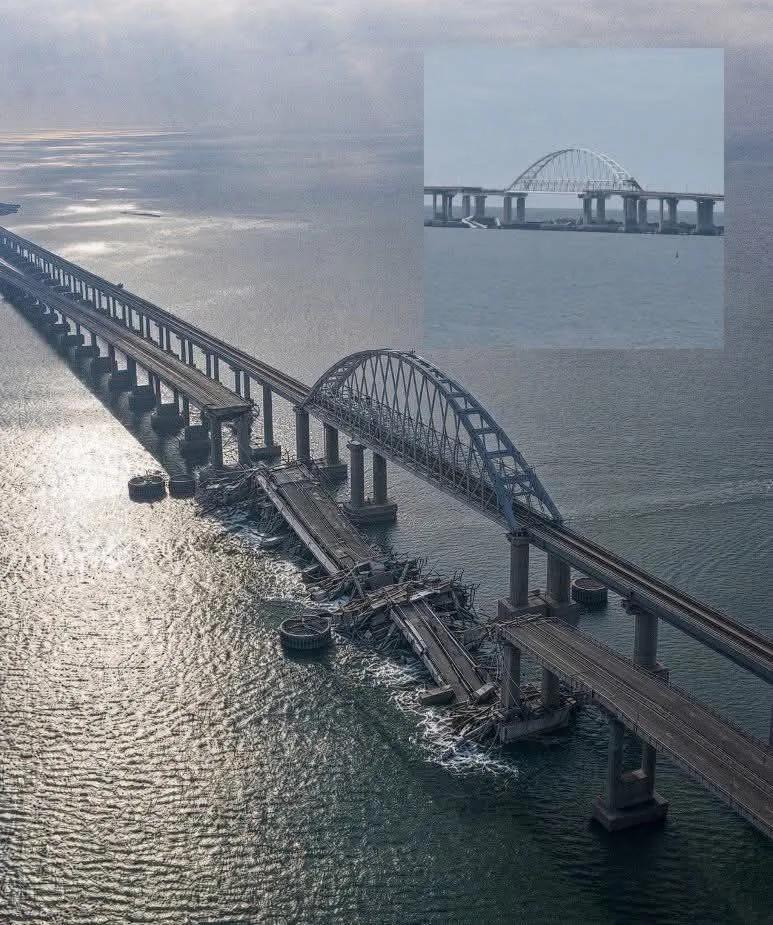
So the target choice is the real change. For three years the question was how to reach the bridge. This time it was which element to reach, and the answer was the element hardest to replace. The operation brought repeated strikes on the same arch, heavy missiles and an operator steering one of them onto it. The public accounts still disagree over which weapon finally dropped the span.
Is this the same playbook Russia uses on Kyiv's bridges?
The sequencing is similar; the target and the timing are not. In early November Russia began hitting Kyiv's bridges over the Dnipro with ballistic salvos built in waves, which I broke down in what it costs to stop one Russian bridge-strike salvo: older missiles first to draw Ukraine's Patriot interceptors, the heavy Iskander-M missiles last into a thinner defense. On the same night as the Kerch strike, Russian missiles hit Kyiv's Northern and Southern bridges again. Two people were killed in Kyiv that night.
Russia compresses the whole sequence into one night and pays for it with ballistic missiles, and the defender has to answer with interceptors that cost about $4 million each, under time pressure. Ukraine stretched the sequence over a month and paid for the early stages with drones. Around Kerch it was the defender that lost radars and launchers it cannot quickly replace, before the expensive missiles flew.
And the two campaigns hit different things. Russia, the aggressor, fires ballistic missiles at river crossings inside Kyiv, a city of three million people, as part of its strikes on Ukraine's cities, power and water. Ukraine struck a military supply route Russia built to sustain its occupation of Crimea, and the General Staff cited Article 51 of the UN Charter, the right of self-defense, in its statement. Zelensky framed the operation as a reply to Russia's strikes on bridges in Zaporizhzhia, Dnipro, Kyiv and the Odesa region, and said every proposal to de-escalate had been refused.
What does the fallen arch block?
The bridge crosses the Kerch Strait over the Kerch-Yenikale Canal, a dredged channel 120 meters wide. The strait around it is shallow, so large sea-going ships moving between the Black Sea and the Sea of Azov depend on that channel. The arch that held the road over it is now in it.
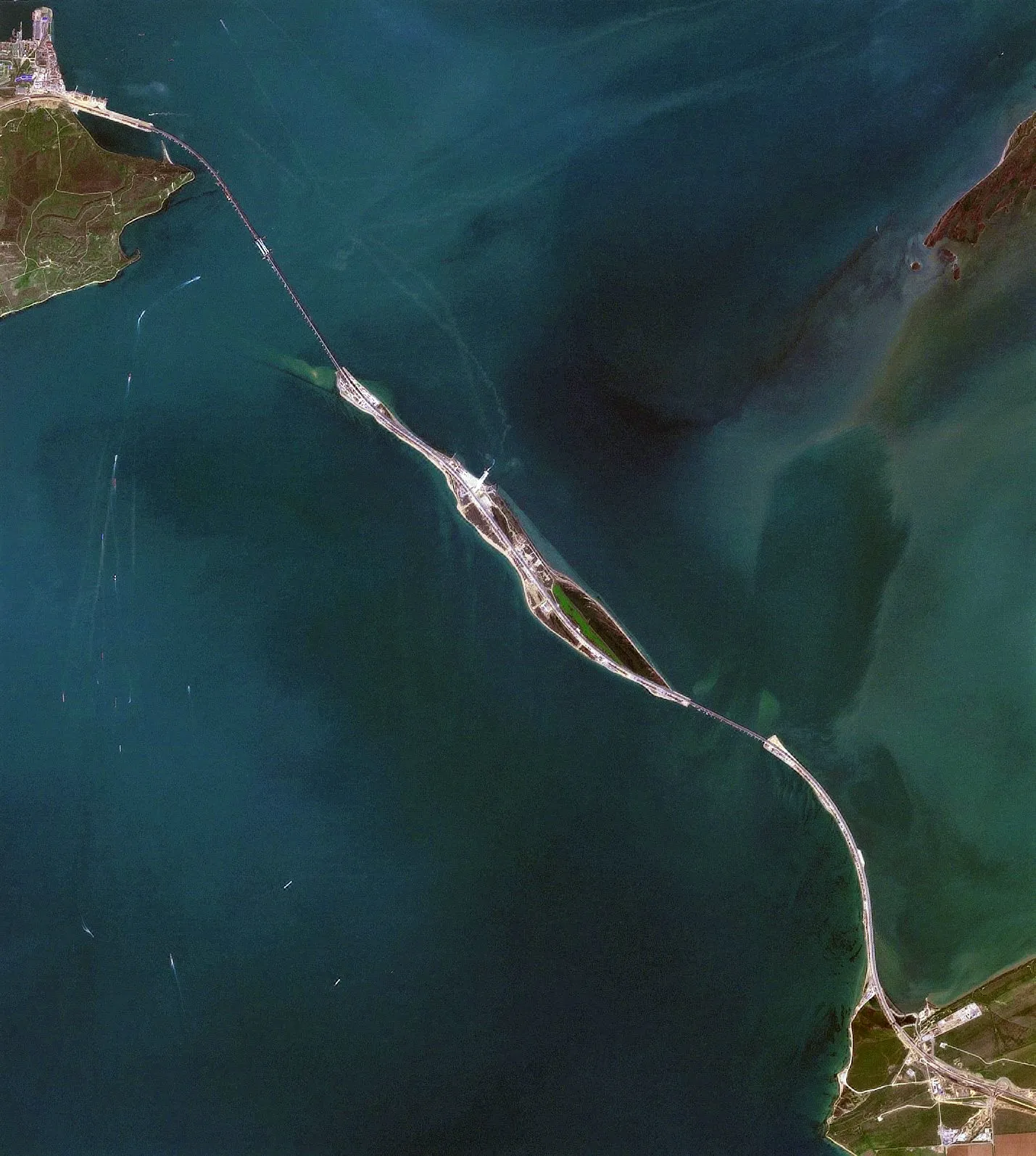
For deep-draft shipping, the Sea of Azov has no other way out. Behind the strait are Russia's Azov ports, Rostov-on-Don, Azov and Taganrog among them, the ports Russia uses in occupied Mariupol and Berdiansk, and the Volga-Don river system that brings oil products and grain down from the interior. Mykhailo Honchar of the Kyiv think tank Strategy XXI expects prolonged disruption for all of it, and for the small warships Russia moves between the Black Sea and the Caspian Sea. He argues Russian Railways cannot carry the diverted cargo.
The trade was already weak. Russia had suspended applications to pass the strait in July after Ukrainian attacks on its ships, and issued grain permits again only in late October, valid until 15 November. In September, shipments of grain from Russia's Azov and Black Sea basin ports were down 93.7% on a year earlier, to 300,000 tonnes, according to UkrAgroConsult. Clearing a steel arch from a shipping channel is a salvage job with heavy-lift cranes and divers, in waters within reach of Ukrainian drones.
This is the part I think most coverage underplays. Russia built the bridge as a military route and a political symbol, and now part of it is lying across its own shipping lane. It has to choose between clearing the wreck first, which reopens the sea lane, and rebuilding the road crossing, which needs the same channel, the same heavy-lift cranes and the same calm water. Honchar expects the disruption to be prolonged. Meanwhile the people cross on the Kerch ferry.
What happens next, and what should you watch?
Russia has said what it will do. Kremlin spokesman Dmitry Peskov said the bridge "will be restored" and "will be even better than before." A government commission under Deputy Prime Minister Marat Khusnullin is working on it. Russia's Investigative Committee opened a terrorism case that mentions only drones, while Kyiv says cruise missiles and missile-drones carried the final stage.
I expect Russia to keep the rail section running at any cost, because the railway is now its only fixed link to the peninsula, and to answer with more strikes on Ukrainian bridges and power, as it did the same night in Kyiv. Zelensky has said more waves may follow.
The signals worth watching:
- Salvage in the channel. Heavy-lift vessels and cranes arriving at Kerch would show whether Russia is clearing the wreck first, which means it is prioritizing its shipping over its symbol.
- The rail arch. If the second arch is hit or found unsafe, the bridge stops carrying anything.
- Strikes on the repair. Further Ukrainian strikes on the crossing, the ferry or the air defense around them would show the campaign moving from disabling the bridge to preventing its repair.
- The Kerch ferry line. It becomes the main crossing again and the obvious next target.
- The Azov ports. AIS data on ships leaving Rostov and Taganrog shows how long the strait stays shut.
What will the market need next?
The method decides what gets bought, and the requirements are now visible:
- Links that survive the last seconds. Today Ukraine's operator-guided deep strike runs, in effect, through one satellite provider. That is a bottleneck, and for now it is the one there is. Datalinks that also run over other networks, relay drones and seekers that recognize the target on their own when the link drops are the answer.
- Cheap drones for air defense. Six of seven stages went to radars, launchers and jammers. That means steady demand, in volume, for low-cost drones that find and hit air-defense radars, and for decoys that make an operator switch a radar on.
- Navigation without GPS. Getting through Russian jamming over hundreds of kilometers needs terrain and visual matching and better inertial units, components every maker in the list buys or builds.
- Mission planning across different weapons. Software that plans routes, keeps missions apart, tracks which defenses are gone and updates the next stage from damage assessment. The buyer is a headquarters running mixed strike packages, not one missile program, and I think this is the least crowded of these markets.
What this means for a defense founder
If you build a strike system, show the buyer where it enters a mixed strike package: what has to happen before launch, what your system removes, and what becomes possible after it hits. The SSU used eleven systems because no single one could do the whole job: some were cheap enough to spend on radars, some were heavy enough for steel, one could be steered.
If you invest, the less obvious exposure sits below the missile brands. Datalinks, seekers, engines, warhead components and mission-planning software sell across several competing airframes, while the airframe makers argue over who dropped the span.
And if you are deciding whether Ukraine's industry can deliver at scale, look at the operation itself: about a month, seven stages, several formations and eleven named systems against a heavily defended military route, ending with a 227-meter road arch in the shipping channel.
Sources (12)
- Kyiv Independent: Entire section of Crimean Bridge collapses after "seven-phase operation," Zelensky reveals, 17 November 2026
- TWZ: What we know about Ukraine's strikes that cut Russia's Kerch Bridge road vehicle span, 17 November 2026
- TWZ: Russia's prized Kerch Bridge struck in Ukrainian drone onslaught, 16 November 2026
- Euromaidan Press: Missile-drones, cruise missiles, and a Flamingo guided to the last second, 17 November 2026
- Euronews: How Ukrainian forces struck Putin's prized and heavily defended Crimean bridge, 17 November 2026
- Interfax-Ukraine: Kerch Strait Bridge road section destroyed, railway section damaged, 17 November 2026
- Interfax-Ukraine: Kerch Bridge strike to disrupt Russian shipping long-term, 17 November 2026
- NBC News: Putin's Kerch Bridge to Crimea partially destroyed by Ukraine strike, 17 November 2026
- UNITED24 Media: Ukraine strikes Crimean Bridge again, 17 November 2026
- Kyiv Post: Crimean Bridge arch collapses into sea after fresh Ukrainian missile strike, 17 November 2026
- UkrAgroConsult: Collapse of Crimean Bridge creates new challenges for Russian grain exports, 17 November 2026
- Wikipedia: Crimean Bridge (cost, spans, repair history)