
Palianytsia is the weapon the SSU credits with dropping the Kerch Bridge span, and its limit is the Czech-Ukrainian engine rather than the warhead
Palianytsia is a jet-powered missile-drone designed by Ukraine's Luch Design Bureau: 650 km, a 100 kg warhead, fired from a trailer with a rocket booster. The SSU says its Alpha unit used it on the road section of the Kerch Bridge on 17 November 2026. I explain what it is, what is public about its cost and production, why it sits between a drone and a cruise missile, and where suppliers can sell into it.
On 17 November 2026 Ukraine's Security Service, the SSU, said its Alpha special forces hit the road section of the Kerch Bridge with Palianytsia missile-drones, and that one steel arch and the roadway under it then fell into the water. President Zelensky said the Palianytsia drones "performed exceptionally well" at the key stage. The bridge links Russia to occupied Crimea; I describe the whole operation, which ran for about a month in seven stages, in how Ukraine cut the Kerch Bridge road span.
Palianytsia is a small jet aircraft built to fly into a target. Ukraine first used it in August 2024, in its defense against Russia's full-scale invasion, which began in February 2022. It is launched from a trailer with a rocket booster, flies on a turbojet at about 800 to 900 km/h and carries about 100 kg of explosive. The name is the Ukrainian word for a round loaf of bread.
My argument is that Palianytsia is best read as a weapon limited by its engine supply rather than by its warhead. A 100 kg warhead is modest. What Ukraine lacks in volume, The Insider reports, is the small turbojet that makes weapons like this fast, and Palianytsia's reported engine is a Czech-Ukrainian design.
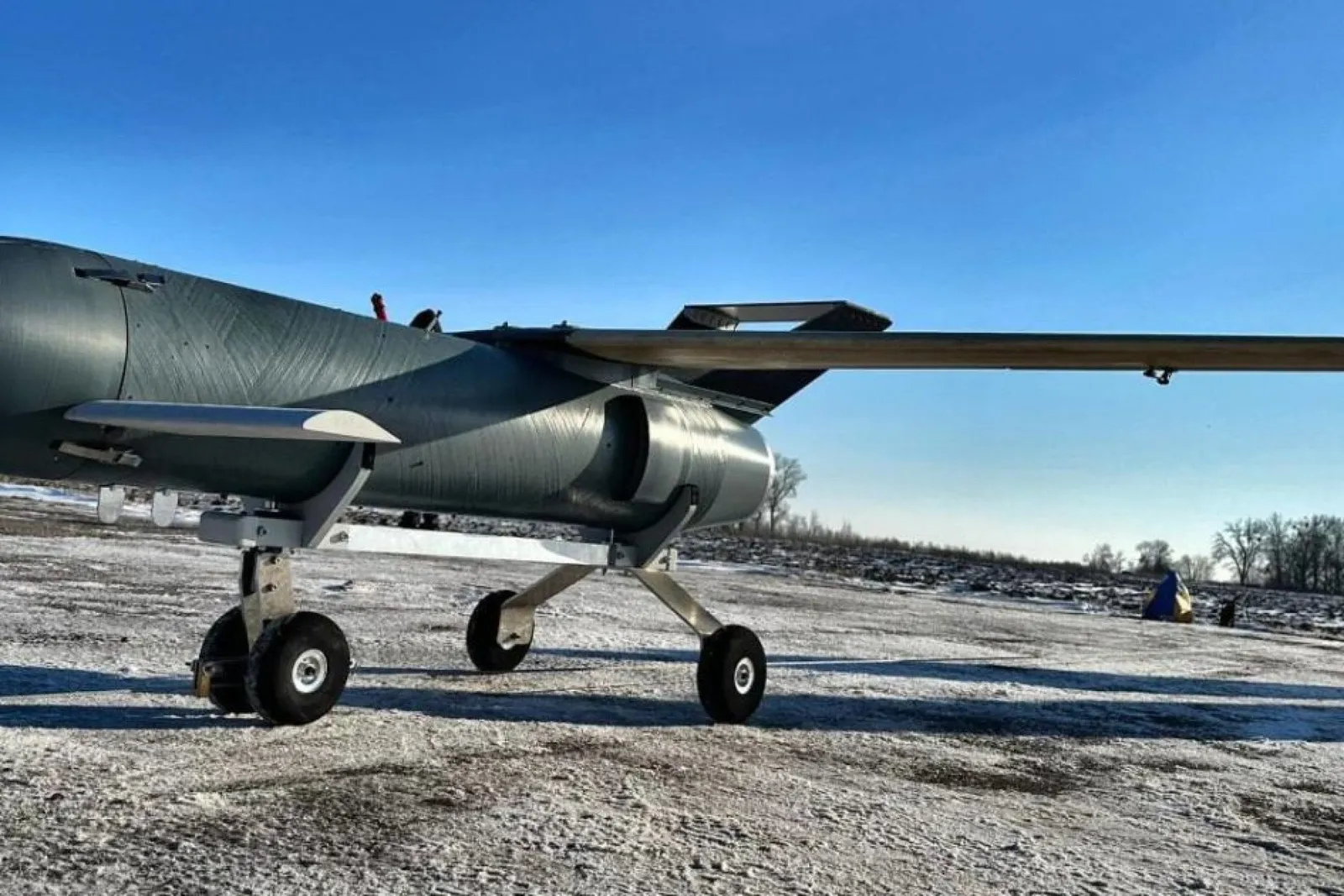
Palianytsia in numbers
| Palianytsia (UAV-290) | |
|---|---|
| Designer | Luch Design Bureau, a state enterprise in Kyiv that also makes the Neptune missile; named by Foreign Minister Andrii Sybiha on 12 January 2026 |
| Presented by | Ukroboronprom, the state defense group, which confirmed the name UAV-290 at the MSPO arms fair in Kielce, Poland |
| First use announced | 24 August 2024 by Zelensky, "a new class of weapon"; about 18 months from design to service |
| Serial production | announced 4 December 2024 by then Defense Minister Rustem Umerov; no output figure published |
| Range | about 650 km (Ukroboronprom, Defense Express); presidential adviser Mykhailo Podolyak said 600 to 700 km |
| Warhead | 100 kg; earlier estimates ran 20 to 50 kg |
| Launch weight | 320 kg (Defense Express) or 350 kg (Ukroboronprom at MSPO) |
| Size | 3.5 m long, 1.7 m wingspan |
| Speed and altitude | up to 800 km/h (Ukroboronprom) or 900 km/h (Defense Express); 15 to 500 m |
| Propulsion | single-circuit turbojet; reported engine AI-PBS-350 (Czech PBS and Ukraine's Ivchenko-Progress), 3,400 N thrust, 51 kg; solid-fuel booster for launch |
| Guidance | inertial navigation with satellite correction; no terrain-matching system reported |
| Launch | trailer or semi-trailer, ground-based |
| Cost | "less than $1 million" per Mykhailo Fedorov, then Ukraine's digital transformation minister, in August 2024; no unit price published since |
Two numbers in the table disagree between sources, the weight and the top speed, and I give both. The 100 kg warhead is the figure Ukroboronprom and Defense Express both use; the smaller estimates came from analysts working from videos before the weapon was shown in Poland.
Why is it called a missile-drone?
Because it sits between two categories and each name describes a different cost. A drone like the Iranian-designed Shahed flies slowly on a piston engine and is cheap. A cruise missile like Storm Shadow flies fast and navigates by matching the terrain below it. Palianytsia has the airframe and the guidance of the first group and the turbojet speed of the second. Defense Express editor Oleh Katkov called the hybrid name odd and said it should be either a jet drone or a cruise missile; analyst Valerii Romanenko preferred "jet drone", because the engine is a turbojet, not a rocket.
The speed buys three things, as Forbes Ukraine's analysts laid out in August 2024. A jet flying at 800 km/h or more gives air defenders far less warning than a slow drone detected hundreds of kilometers out. It spends less time inside the defender's radar coverage. And lift grows with speed, so a faster airframe of the same size carries a larger warhead. Their illustration was a drone with two to three hours of warning against a jet with 20 to 30 minutes; I treat that as the logic, not a measurement.
The trade-off is the one Katkov made on the same page: "a more mass-produced weapon, even a less refined one, may be needed now." A turbojet costs more than a small piston engine, and without terrain matching the aircraft depends on inertial navigation and satellites. That makes it a good tool against fixed targets whose coordinates are known, which is what Ukroboronprom says it was designed for, and a poor tool against anything that moves.
What does it cost, and how many are made?
The only official price is "less than $1 million." The useful comparison is per kilogram of warhead. At the $1 million ceiling, Palianytsia's 100 kg works out to at most $10,000 a kilogram, which is close to the roughly $8,100 a kilogram of a Tomahawk Block V; at a tenth of the ceiling it would be a tenth of that. The real figure is somewhere below the ceiling and nobody has published where. I use the Tomahawk and Anduril comparison in Barracuda's numbers, where the same arithmetic gives $3,300 to $4,400 a kilogram.
Production is the harder gap. Umerov announced serial production in December 2024. The Insider wrote in 2026 that there is no reliable public data on how many Palianytsia have been launched or how often, and that its operating unit has not been disclosed. Lithuania pledged 10 million euros toward Palianytsia systems in autumn 2024. That is the only outside funding I can source.
Where does the engine come from?
The reported engine, the AI-PBS-350, was developed by the Czech company PBS Velka Bites and the Ukrainian state firm Ivchenko-Progress, under a memorandum signed in June 2023. It weighs 51 kg and produces 3,400 newtons of thrust. The Insider reports that about a quarter of PBS's engine deliveries go to Ukraine, and that turbojet shortages limit jet missile-drones in general.
That is the point for suppliers. The warhead and the airframe can be made in many places, so the engine sets how many leave the factory each month. The same limit appears in interceptor drones, which I cover in the engine bottleneck, and in the Russian Geran-5 jet Shahed, which Russia uses against Ukrainian cities and needs the same class of engine for.
What did it do at the Kerch Bridge?
The SSU's account is that Alpha used Palianytsia on the road section during the seventh and last stage of the operation. The earlier six stages destroyed air defense, radars and electronic warfare on the way in; the day before, a drone strike had damaged and tilted the arch over the shipping channel. The rail section was hit by Neptune missiles, Ruta and the FP-5 Flamingo.
Two reasons make me cautious about the simplest reading, which is that Palianytsia dropped the bridge. First, Destinus, the company with Dutch venture money that makes Ruta, said on the day that seven Ruta missiles hit the bridge and one span collapsed, which is a different credit for the same event. Second, 100 kg of explosive against a steel arch does not bring it down on its own; the arch had been weakened the day before and the strike came in a sequence. What the evidence supports is that Palianytsia was the weapon Ukraine chose for the road section and that the road section fell. Damage assessment is still Ukrainian official statements; I have not seen an independent one.
Palianytsia had already been used in combination before. On the night of 11 to 12 August 2026 Ukraine hit the Novorossiysk naval base with 15 domestic systems, and Kyiv Post reported that Palianytsia, Peklo and Bars (Ukrainian jet missile-drones) and Long Neptune (a longer-range version of the Neptune missile) were used together in one operation for the first time. The Insider adds the 20 September attack on Moscow and the 26 September strike on the Azov Optical-Mechanical Plant as other uses. Both are single-source.
What will the market need next?
The pattern in Ukraine's strike mix is that a weapon like this is bought in salvos with others, and what it needs most is small, repeatable parts.
- Small turbojets, 3,000 to 4,000 newtons. The class that PBS and Ivchenko-Progress occupy. A second source in Ukraine, Europe or the US sells to Palianytsia, to Barracuda-type missiles, to jet interceptors and to every future long-range one-way jet. The buyer is the maker, not the army; the price is the engine's share of a missile that costs under a million dollars.
- Jam-resistant navigation without terrain matching. Palianytsia flies on inertial and satellite navigation. A unit that adds a camera or radar fix for the last 20 km, at a price a sub-million missile can carry, is the missing piece against targets with jamming around them.
- Warhead variants. The reported 100 kg warhead is a single type. Penetrating, fragmentation and bridge-attack options each have different fuzes and buyers. A warhead and fuze supplier that can qualify a variant for a trailer-launched jet is selling into a gap.
- Launch and handling equipment. A trailer, a booster, a loader and a way to hide them. The cheaper the missile, the more of the cost sits in the launcher, which is a small, specialized business.
- Production funding. The Danish model of paying Ukrainian makers directly in Ukraine, which I describe in how Western money reaches Ukrainian producers, applies. Lithuania's 10 million euros in autumn 2024 is the precedent.
What Palianytsia means for a defense founder
- Sell the part that sets the rate. If your product is the engine, the navigation unit or the fuze, say how many a month you can deliver and who else can. A maker with a Czech engine and a Ukrainian airframe is a buyer for a second source.
- Make the price public. The weapon with a published ceiling and no unit price is argued about by journalists for two years. A supplier who states a unit price at volume gets compared fairly.
- Expect the combined salvo. Ukraine used Palianytsia in the same operation as Neptune, Ruta and Flamingo at the bridge, and in one strike with Peklo, Bars and Long Neptune at Novorossiysk. A product with a different range, speed or warhead has a place in that mix.
Sources (15)
- UNITED24 Media, Ukraine reveals who built its Palianytsia cruise missile, 13 January 2026
- Militarnyi, Ukroboronprom reveals designation of Palianytsia missile-drone
- Kyiv Post, Ukraine upgrades Palianytsia drone missile, 3 September 2025
- Army Recognition, Ukraine starts mass production of Palianytsia, 5 December 2024
- Forbes Ukraine, Palianytsia: how a missile-drone helps Ukraine hit airfields in Russia, 27 August 2024
- The Insider, Peklo to Palyanytsya: Ukraine's expanded long-range arsenal
- Wikipedia, Palianytsia (missile), engine and cost entries
- Aviation Week, Czech, Ukrainian companies team up for new missile engine
- Kyiv Post, Ukraine's 15-weapon Novorossiysk strike, 13 August 2026
- Ukrinform, Zelensky announces unique operation to strike the naval base in Novorossiysk, 12 August 2026
- UNITED24 Media, Zelenskyy reveals what missiles and drones struck the Crimean Bridge, 17 November 2026
- Kyiv Post, From Flamingo to Neptune: Zelensky reveals details of the Crimea Bridge strike, 17 November 2026
- Euromaidan Press, Missile-drones, cruise missiles, and a Flamingo guided to the last second, 17 November 2026
- UNIAN, SSU on how the Crimean Bridge operation was carried out, 17 November 2026
- TWZ, What we know about Ukraine's strikes that cut Russia's Kerch Bridge road span, 17 November 2026
Where this comes up on the site
- Ukraine spent a month taking apart the Crimean Bridge's defenses, then hit one arch two nights running. How eleven Ukrainian weapons dropped the span
- The An-197 was named in the Crimean Bridge strike and described nowhere. What is known, and what it is most likely built on
- Dovbush started as an $8,000 scout that volunteers gave to the army, and in 2026 the T40 version is how Ukraine sees 2,000 km deep