
The Kalibr cruise missile and the half-life of an expensive weapon
The 3M-14 Kalibr is Russia’s sea-launched land-attack cruise missile: precise, long-ranged and made at a few dozen a month. My argument is that it shows the half-life of an expensive weapon: its value falls as the defender learns it and as the ships that carry it become targets. Here is the mechanism, where the Kalibr goes next and what that means for the market.
The Kalibr cruise missile is what a strike weapon looks like when it is built the traditional way: a precise, long-range, sea-launched missile from a state design bureau, made at a few dozen a month and priced in millions. Russia has fired it at Ukrainian cities, power plants and military targets since the first morning of the full-scale invasion. Set next to the Shahed drone and the Banderol, and alongside its air-launched counterpart, the Kh-101, it marks the expensive end of the same market, and its record shows what happens to that end once the defender learns it.
My argument is that an expensive precision weapon has a half-life. It is most valuable on the first day, when the defender has not seen its flight profile and its launch platforms are safe. Every month after that, both advantages decay. The Kalibr is the clearest case of that decay in Russia's war against Ukraine, and Russia’s choices in 2026, cluster warheads and a strike campaign built on cheap mass, are what the decay looks like from the inside.
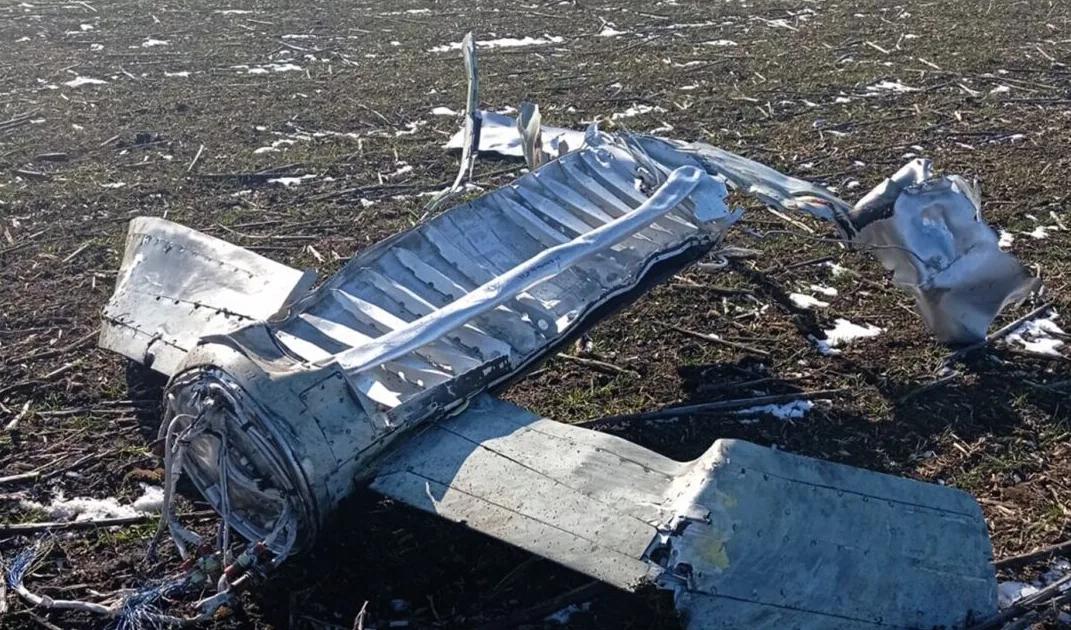
What is the Kalibr?
The 3M-14 Kalibr, NATO name SS-N-30A, is a land-attack member of the Kalibr missile family developed by the NPO Novator design bureau in Yekaterinburg, part of the Almaz-Antey state group. It launches from surface ships through a universal vertical launcher and from submarines through torpedo tubes. The export branding of the family is Club; the export land-attack version, the 3M-14E, is limited to about 300 km, which keeps it under the Missile Technology Control Regime threshold of a 500 kg payload beyond 300 km. The domestic version flies five to eight times as far.
The Kalibr in numbers
| Figure | Value |
|---|---|
| Developer | NPO Novator, Yekaterinburg (Almaz-Antey) |
| Length, diameter, wingspan | about 6.2 m, 533 mm, about 1.7 m |
| Warhead | about 450 kg high-explosive; cluster warheads reported from spring 2026 |
| Range | about 1,500 to 2,500 km (export Club: about 300 km) |
| Speed | subsonic, about Mach 0.8 (980 km/h) |
| Flight altitude | about 20 to 50 m in cruise, as low as 10 m near the target |
| Guidance | inertial and satellite navigation, radio altimeter for terrain following, active radar seeker at the end |
| Launch platforms | frigates, Buyan-M corvettes, Kilo-class submarines; the Caspian Flotilla as well as the Black Sea Fleet |
| Contract price | about RUB 168 million, roughly $2 million per missile; a 2022 outside estimate put it above $6.5 million |
| Production | 30 to 40 a month by Ukraine’s intelligence estimate in May 2024 |
| Stock | about 450 in August 2026, by the same service |
The claim that the Kalibr flies at Mach 3 comes from a different member of the family: the supersonic final stage of the 3M-54 anti-ship missile. The land-attack 3M-14 is subsonic.
Where has it been used?
Its first combat launch was a statement. On 7 October 2015 four small ships of the Caspian Flotilla fired 26 missiles at 11 targets in Syria, about 1,500 km away, showing that corvettes on an inland sea could do what used to take a large navy. In December 2015 a Kilo-class submarine fired four from underwater in the Mediterranean.
Against Ukraine it was in the first volley on 24 February 2022, an estimated 30 missiles from Black Sea Fleet ships and submarines aimed at command posts, airfields and air defense. The Caspian Flotilla joined on 20 March 2022 with a strike on a fuel depot in the Mykolaiv region, fired without a single ship entering the Black Sea.
How much does a Kalibr cost, and how many does Russia have?
Recent Russian procurement documents, as reported by Militarnyi, show two large contracts: 240 missiles for 2022 to 2024 and 450 for 2025 to 2026, at about RUB 168 million, roughly $2 million, each. Novator was also tasked with 56 missiles of a nuclear-capable 3M-14S version for delivery between 2024 and 2026. The $6.5 million figure that circulated in 2022 was an outside estimate made before those documents surfaced; the two should not be read as a price increase or a price cut.
Output is measured in dozens. Ukraine’s intelligence estimated 30 to 40 a month in May 2024 and about 450 in stock in August 2026, and said Russia beat its July 2026 Kalibr production target without giving the target. Russia’s total output of cruise and ballistic missiles of all types was put at over 200 a month.
Why is the Kalibr less of a problem than it was?
Because the defender learned it. Ukraine’s Air Force reported shooting down 709 Kalibrs between February 2022 and February 2026. CSIS found Russian Kalibr use in early 2025 had fallen to about a fifth of its 2022 to 2023 level, under pressure from Ukrainian air defense and from Ukrainian strikes that pushed the Black Sea Fleet out of Sevastopol toward Novorossiysk. By August 2026 the Institute for the Study of War assessed Ukraine’s Kalibr interception rate at nearly 100%.
Even so, each of those interceptions is a fair trade by the arithmetic I describe in cost-exchange ratio. A $2 million missile carrying 450 kg of explosive justifies an expensive interceptor. A $35,000 drone does not. That is why Russia’s growth has come at the other end of the market, and why the hard problem for air defense is now cheap mass, as in why a cheap cruise missile is hard to stop.
The half-life of an expensive weapon
Two clocks run against a weapon like the Kalibr from the moment it is first used.
The first is the defender's learning clock. A cruise missile is a known object after a few dozen launches: its speed, its cruise altitude, its routes around radar, the points where it turns toward the target. Ukraine went from losing most of the first salvos to intercepting nearly all Kalibrs by 2026. Nothing about the missile changed. The defender's sensors, interceptors and crews did. A cheap drone faces the same clock, but a drone costs so little that the attacker can change its shape, speed and tactics every few months; a missile from a state design bureau changes over years.
The second is the platform clock. The Kalibr was the core of what the US Navy's journal called the "Kalibrization" of the Russian fleet: put long-range missiles on small corvettes and submarines, and a modest navy gains reach that used to need large ships. That works while the hulls are safe. Ukraine's naval drones and strikes on the ports made the hulls targets, the Black Sea Fleet moved east, and Kalibr use fell to about a fifth of its early level. A missile is only as available as the ship that carries it.
Put the two clocks together and the economics turn. A $2 million missile that is nearly always intercepted is no longer a strike weapon; it is an expensive way to make the defender spend an interceptor. That is the logic I read in Russia's 2026 decisions. Cluster warheads trade precision for area effect, which matters more when only a few missiles get through. And the growth of the arsenal moved to Shahed-type drones, the Geran-5 and the Banderol, weapons cheap enough to be replaced as fast as the defender learns them.
Where does the Kalibr go next?
I see three roles for it over the next two to three years, and the likely outcome is a mix.
- Saturation partner. Kalibrs fired in the same raid as jet drones and decoys, so that the defender's best interceptors are spent on the drones and the missiles get through, or the other way round. The missile's job becomes to complicate the defender's choice.
- Reserved strike. A smaller number kept for targets that justify $2 million and a long flight: command posts, energy nodes, and the nuclear-capable 3M-14S role. Production in the dozens a month and a stock in the hundreds fit this better than a daily campaign.
- Export product. The Club export family competes on price and on being combat-proven. A record of near-total interception in Ukraine is a poor sales argument, and I expect the export market for this class to shrink toward buyers who cannot get Western or Chinese alternatives.
The signals that tell you which way it is going: the share of Kalibrs in each raid; whether launches come from the Caspian, far from Ukrainian drones, rather than the Black Sea; how often cluster warheads appear; and whether reported production rises above the 30 to 40 a month of 2024 or stays there while drone output keeps growing.
The Black Sea coast faces a second Russian sea-launched threat that behaves differently. The Oniks, an anti-ship missile Russia fires at Odesa from coastal launchers in occupied Crimea, skims the water at twice the speed of sound, so a Kalibr's long flight and an Oniks's few seconds of warning need different sensors.
What will the market need next?
The half-life argument points at a product the West needs for its own arsenal: ways to keep an expensive missile current after it has been built. Modular seekers, anti-jam navigation and software that can be updated in the depot extend the life of missiles already in stock, and every Western army holds thousands of rounds designed before Russia's jamming and drones changed the war in Ukraine. Upgrade kits for existing stocks are a larger market than new missiles of the same class, and they are bought from a maintenance budget that moves faster than a new programme.
The other market is on the water. Ukraine's naval drones pushed the Black Sea Fleet east and with it the launch platforms for Kalibrs. Navies and port operators now buy protection for ships and harbours against cheap sea drones, and makers of those drones sell to navies that want the same reach Ukraine has, the market in maritime drones.
Signals worth watching: upgrade contracts for in-service Western missiles, port and harbour protection tenders against sea drones, and Kalibr launch numbers in Ukrainian Air Force reports.
What it means for a founder
For a founder, the Kalibr is a reference point more than a target. A product that only works against threats like this sells into a market where the buyer already has an answer and is running out of money to use it. The open market is below it, where threats are cheaper, more numerous and newer, the subject of the risks of cheap missiles at 80, 150 and 400 a month. The half-life argument also cuts the other way: any expensive Western weapon faces the same two clocks, which is why buyers now ask how fast a product can change, not only how well it performs on the day it is delivered.
The second lesson is about mass. An expensive, excellent weapon is still worth having, and experience can bring its price down. But with limited resources, many cheaper units that each do less damage break through a defense by numbers: 100,000 drones instead of 100 missiles, 10,000 small ground robots instead of one large one carrying lidars. Missiles are still needed; they are no longer the whole answer.
The Kalibr story also carries the same supply-chain lesson as every other Russian weapon taken apart in Ukraine. According to Ukraine’s defense ministry, as reported in June 2026, examined homing boards built in 2025 still had 80 to 90% foreign electronics.
Sources (11)
- CSIS Missile Threat, SS-N-30A Kalibr, 23 April 2024
- Militarnyi, from Kalibr to Kinzhal: how much do Russian missiles really cost, 3 October 2026
- Ukrainska Pravda, Russia’s missile stockpiles and production, 20 August 2026
- Defence Blog, Ukraine confirms interception of over 140,000 aerial targets since 2022, 24 February 2026
- CSIS, breaking down Russian missile salvos, 24 February 2025
- Institute for the Study of War, Russian offensive campaign assessment, 10 August 2026
- Defence Viewpoints, fire from the sea: Russian naval land-attack missiles, 16 August 2026
- USNI Proceedings, the Kalibrization of the Russian fleet, May 2022
- Arms Control Wonk, Russian cruise missiles revisited, 27 October 2015
- Euromaidan Press, Russia switched Kalibr missiles to cluster warheads, 10 June 2026
- Reuters, why Russia’s missiles on Ukraine have limited impact, 11 October 2022
Where this comes up on the site
- The Kh-101 and Russia’s two-ended arsenal: why the most expensive missile grows alongside the cheapest drone
- Russia holds more than 600 Oniks missiles, and against Odesa it beats the defense with the curvature of the Earth, not with speed
- ePPO turned 700,000 phones into the cheapest air-defense sensor in Ukraine, because the threats radar misses are the ones people can see